
Quick Summary:
A/B testing of YouTube thumbnails and titles allows creators to compare multiple variations of video packaging to identify which version attracts the most viewers and generates the strongest engagement. Instead of relying on instinct alone, creators can test titles, thumbnails, or full packaging combinations directly in YouTube Studio and measure how real audiences respond. Because YouTube’s recommendation system responds to viewer behaviour, small improvements in click-through rate and watch time can significantly increase a video’s reach over time. By testing emotional cues, visual simplicity, and title structure, creators can turn video packaging into a measurable performance lever rather than a one-time creative decision.
Why do thumbnails and titles determine whether a video gets watched?
Before someone watches a video, they make a very small decision: Is this worth clicking? That decision happens quickly (often in less than a second), and it is shaped almost entirely by two elements: the thumbnail and the video title.
Together, these form what YouTube refers to as video packaging. Packaging determines how viewers interpret a video before they even press play. If the packaging sparks curiosity or clearly communicates value, the viewer clicks. If it doesn’t, the video is ignored.
This behaviour directly affects click-through rate (CTR) — the percentage of people who click your video after seeing it in search results, recommendations, or the YouTube homepage. Even small improvements can have a meaningful impact.
| Approximate Metric | What it Typically Indicates |
| 3–5% CTR | Average performance |
| 6–8% CTR | Strong packaging |
| 10%+ CTR | Highly compelling packaging |
Because YouTube’s recommendation system observes how audiences respond to videos in real time, these small differences matter. When viewers consistently choose your video over others, the platform learns that your content is worth recommending more broadly.
This is why thumbnail and title design is no longer just a creative exercise — it’s a strategic performance lever. Packaging influences whether viewers click, while metadata and keywords help YouTube understand what the video is about. For a deeper look at how search optimization influences video visibility, see Blacksmith’s guide to YouTube SEO.
Why are creators moving from static thumbnails to data-driven testing?
For many years, thumbnail design relied primarily on creative judgment. A designer would develop one visual concept, publish the video, and move on to the next piece of content. That approach worked when video was treated mainly as a supporting asset.
Today, however, YouTube has become a major discovery engine. Videos compete with hundreds of others in search results and recommended feeds. In that environment, relying on a single design decision leaves too much to chance.
Structured A/B testing introduces a more deliberate approach. Instead of committing to a thumbnail immediately, creators test several variations and let real audience behaviour determine which version performs best.
This shift mirrors the evolution of other digital marketing practices. Landing pages are A/B tested. Email subject lines are tested. Advertising creatives are tested. Video packaging is now following the same path.
When creators adopt testing frameworks, they gain something extremely valuable: clarity. Rather than debating which thumbnail “looks better,” the decision is guided by measurable viewer behaviour.
Over time, those insights accumulate. Patterns begin to emerge, helping teams understand what their audience responds to most consistently.
Who can access YouTube A/B testing?
YouTube’s built-in A/B testing tools allow eligible creators to run A/B experiments on video titles and thumbnails directly inside YouTube Studio. The feature is currently available to channels that have access to Advanced Features, though availability may vary by region and account as YouTube continues to roll it out.
Requirements
To access A/B testing in YouTube Studio, creators must:
- Have Advanced Features enabled on their channel
- Upload public long-form videos eligible for testing
Supported Content Types
The Test & Compare tool currently works for:
- Public long-form videos
- Recorded live streams
- Podcast episodes (if published)
Not Currently Supported
The feature is not currently available for:
- YouTube Shorts
- Private videos
- Content marked “Made for Kids”
What can you test with YouTube’s “A/B Testing” tool?
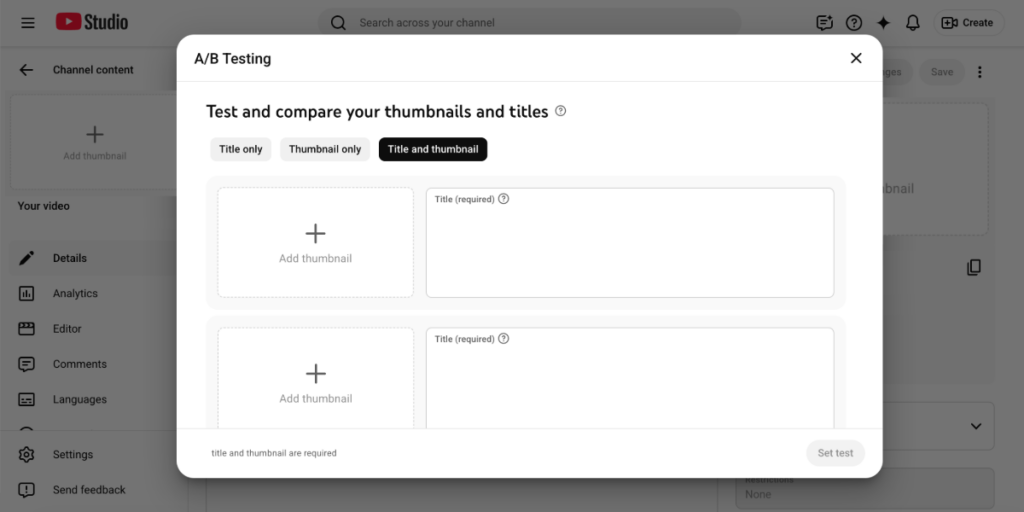
YouTube allows creators to run three different types of experiments within a single video upload.
Although the feature is commonly called “A/B testing,” YouTube actually allows creators to test up to three variations at once. In practice, this makes it closer to an A/B/C test, allowing multiple packaging ideas to compete within a single experiment.
- Title only — Creators can test up to three different titles while keeping the same thumbnail. This helps isolate how messaging and wording influence viewer clicks.
- Thumbnail only — Creators can test up to three thumbnail variations with the same title. This helps identify which visual design, imagery, or composition attracts more viewers.
- Title + thumbnail pairs — Creators can also test up to three complete packaging combinations by pairing different titles and thumbnails.
This allows creators to isolate which element is influencing viewer behaviour: the visual design, the messaging, or the combination of both.
How does YouTube thumbnail A/B testing work in YouTube Studio?
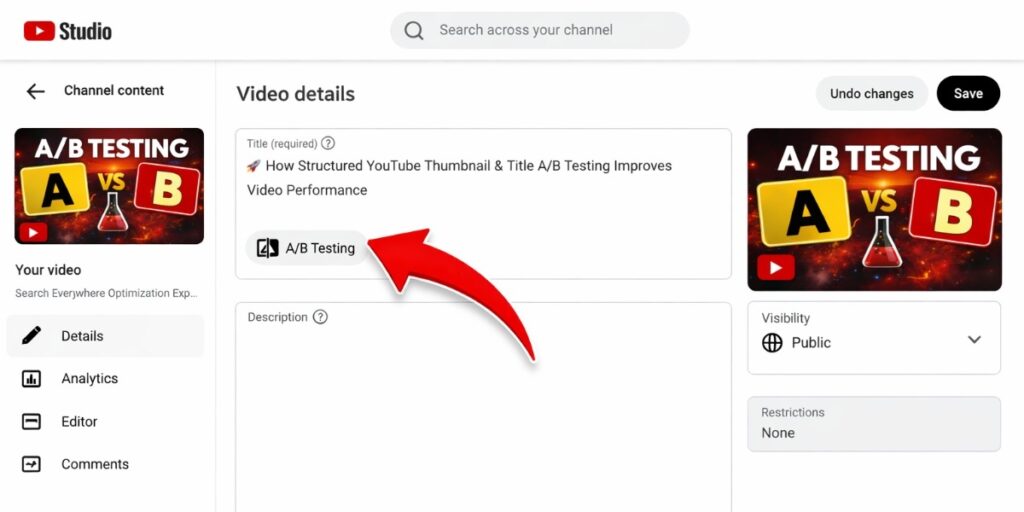
YouTube Studio includes built-in tools that allow creators to test multiple thumbnail or title variations on the same video. When a test is active, YouTube automatically rotates the variations across viewers and measures how audiences respond. The goal is to identify the video packaging that generates the strongest engagement.
The Basic Testing Process
Running an experiment in YouTube Studio typically follows a simple workflow:
- Upload two or three thumbnail or title variations
- YouTube distributes impressions across the variations
- Viewer engagement metrics are tracked automatically
- Once enough data is collected, the platform identifies the highest-performing version
Because the platform distributes impressions automatically, creators do not need to manually manage the experiment once it begins.
Where to Start an A/B Test in YouTube Studio
You can launch an A/B test during the video publishing process or after a video is already live inside YouTube Studio. Creators simply add the title or thumbnail variations they want to test and start the experiment.
Testing periods usually run from several days to two weeks, depending on how quickly the video accumulates impressions.
When the test concludes, YouTube selects the best-performing variation and applies it to the video automatically. Creators can review the results in the video details report and still choose to keep the winning version or manually select another option.
Metrics YouTube Uses to Determine the Winner
Several engagement signals help determine which thumbnail or title performs best.
| Metric | Why it matters |
| Click-Through Rate (CTR) | Measures how often viewers click the video |
| Impressions | Shows how often the video appears to viewers |
| Watch Time | Indicates how long viewers stay engaged |
| Audience Retention | Signals overall viewer satisfaction |
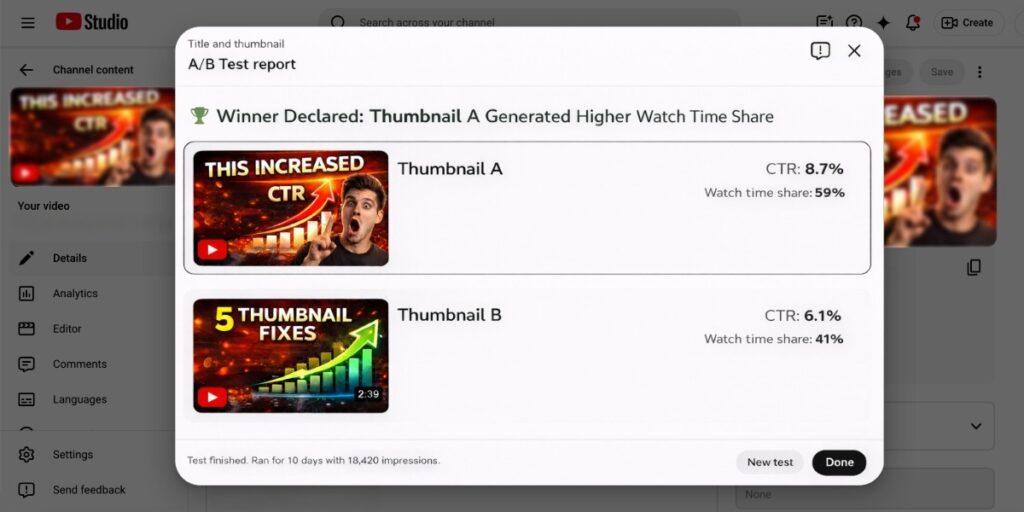
In YouTube’s native A/B Testing system, the winning variation is typically determined by watch time share, rather than CTR alone. This helps ensure the selected thumbnail attracts viewers who actually stay and watch the video.
Can YouTube A/B testing reduce impressions or slow video performance?
YouTube’s A/B testing tools are designed to evaluate different thumbnails and titles without harming a video’s long-term performance. However, some creators find that testing can influence how quickly early engagement signals develop.
When a test is running, impressions are temporarily distributed across multiple variations. On videos with limited impressions, this means engagement data is split while YouTube gathers enough information to determine which version performs best.
Because of this, some creators report slower early performance during testing, as impressions are split between variations. In those situations, one strong thumbnail may sometimes perform better than several similar options competing for the same impressions.
For this reason, testing is often most useful when a video already has steady impressions, but click-through rate is underperforming, or when creators want to refine their thumbnail and title strategy over time.
When A/B testing may not be effective
A/B testing relies on sufficient data to produce meaningful results. For videos with very low impressions, tests can take significantly longer to reach statistical significance because engagement data is split across multiple variations.
As a general guideline, videos with limited traffic may not generate enough data within a typical 7–14-day testing window to produce a clear winner. In these cases, focusing on a single strong thumbnail or title may be more effective than running a test.
What psychology influences whether viewers click a thumbnail?
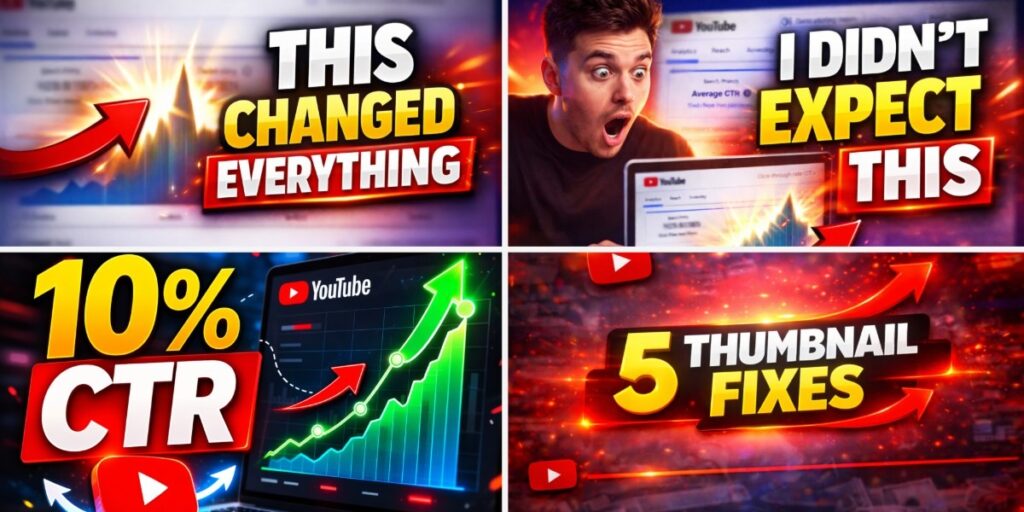
Because viewers scan YouTube quickly, thumbnails must communicate meaning almost instantly. Several psychological cues consistently influence click behaviour:
Curiosity and the information gap
One of the most reliable drivers of engagement is curiosity. When a thumbnail hints at an outcome without revealing the full story, viewers experience what behavioural researchers call the information gap — the desire to resolve missing knowledge.
For example, a thumbnail might tease a surprising result with text like “This Changed Everything.” The viewer clicks because they want to understand the full context.
Emotional recognition
Humans are highly responsive to facial expressions and emotional cues. When viewers see a human reaction — surprise, concern, excitement — they quickly interpret the content’s emotional tone.
A thumbnail featuring a surprised expression paired with text like “I Didn’t Expect This” signals a strong emotional moment that viewers are curious to experience.
Cognitive ease
Thumbnails are processed in milliseconds, which means simplicity matters.
High-performing designs usually feature:
- one clear focal subject
- limited on-screen text
- strong contrast
- easily recognizable imagery
Simple visuals paired with clear messaging — such as “10% CTR” — make the takeaway immediately understandable.
Value and outcome signalling
Another effective thumbnail approach is clearly communicating the value a viewer will gain from watching the video. Instead of relying primarily on curiosity or emotion, these thumbnails highlight the result or takeaway.
This style is common in tutorial and educational content where viewers are actively searching for solutions. Phrases like “5 Thumbnail Fixes” signal that the video will deliver specific, actionable information, helping viewers quickly decide whether the content is relevant to them.
How do video titles influence click-through rate?
While thumbnails capture attention visually, titles provide context. Together, they complete the click decision.
Strong titles tend to balance search intent with viewer curiosity. They help viewers understand what they will gain by watching the video while still leaving room for intrigue.
| Title Approach | Example |
| Curiosity | “What Nobody Tells You About YouTube CTR” |
| Numbers | “5 Thumbnail Mistakes Killing Your Views” |
| Direct value | “How to Improve Your YouTube Click-Through Rate” |
Titles should remain clear and readable rather than overly clever. The goal is to communicate value quickly while aligning with how viewers search for information. In addition to improving click-through rate, well-structured titles and metadata also help search engines understand the topic of a video. Implementing structured data such as video object schema can further improve how video content appears in search results.
Strong titles also help YouTube understand what a video is about. Titles aligned with search intent and relevant keywords can significantly influence discoverability, particularly for videos that receive traffic from YouTube search.
For this reason, many creators experiment with both titles and thumbnails together to understand how messaging and visual design interact.
Two simple title testing strategies
When running title-only A/B tests, it can be helpful to compare fundamentally different messaging approaches rather than small wording changes. Two common strategies include:
Benefit-driven vs. curiosity-driven titles: One variation clearly communicates the value of the video (e.g. “How to Improve Your YouTube CTR”), while another introduces an information gap (e.g. “Why Your CTR Is Lower Than You Think”).
Specific vs. broad framing: One title highlights a precise outcome or number (“5 Thumbnail Fixes That Increased CTR”), while another keeps the framing more open-ended (“How to Improve Your Thumbnails”).
Testing structurally different approaches like these often produces clearer insights than minor wording adjustments.
What are the technical requirements for YouTube thumbnails?
In addition to creative considerations, thumbnails must meet specific technical guidelines to display correctly across devices:
| Requirement | Specification |
| Recommended size | 3840 x 2160 pixels |
| Minimum width | 640 pixels |
| Aspect ratio | 16:9 |
| Maximum file size | 2MB Mobile / 50MB Desktop |
| Accepted formats | JPG, PNG, GIF |
These specifications ensure thumbnails appear clearly across desktop, mobile, and smart television interfaces. Designing within these constraints helps maintain image quality and readability, particularly on smaller screens.
How have thumbnail trends evolved from clickbait to credibility?
Early YouTube growth strategies often relied on exaggerated “clickbait” thumbnails designed to generate immediate attention. Large text, dramatic imagery, and extreme facial expressions were common tactics.
While these designs sometimes produced higher CTRs in the short term, they often created a mismatch between viewer expectations and the actual video content. When viewers felt misled, they abandoned videos quickly. That behaviour sends negative signals to the recommendation system and can limit long-term reach.
More recently, many creators have shifted toward trust-based curiosity. Rather than exaggerating claims, successful thumbnails focus on clearly communicating the value of the content while still sparking interest.
This approach builds stronger viewer relationships and tends to support more sustainable channel growth.
What insights often emerge from structured thumbnail testing?
When teams begin running consistent tests, they frequently uncover patterns that would have been difficult to predict beforehand.
Across multiple SEO-driven video content projects, several patterns tend to appear repeatedly:
- Curiosity-based thumbnails often outperform purely descriptive designs
- Simple layouts tend to generate higher CTR than complex visuals
- Human expressions frequently increase engagement
- Clear, readable text performs better than decorative typography
The most valuable outcome, however, is not a single “winning” thumbnail. Instead, testing reveals how your specific audience responds to different visual cues and messaging styles. Over time, those insights form the foundation of a repeatable creative strategy.
How YouTube reports A/B testing results
Once enough data has been collected, YouTube Studio typically reports one of three outcomes:
- Winner: One variation clearly outperformed the others
- No Winner: Results were too similar to determine a clear result
- Running: The test is still collecting viewer data
When a winner is identified, YouTube will automatically apply the highest-performing version to the video.
What are the best practices for running effective thumbnail tests?
To produce meaningful results, thumbnail testing should follow a consistent structure. A few practical guidelines can improve the reliability of test outcomes:
- Test one major variable at a time
- Allow 7–14 days for impressions to accumulate
- Compare CTR alongside watch time and retention
- Keep titles consistent when testing thumbnail visuals
- Focus on emotional framing rather than minor design tweaks
Testing works best when thumbnail variations are meaningfully different. Small visual tweaks often produce inconclusive results because viewer behaviour does not change enough to produce clear data. As these experiments accumulate, creators begin to develop a clearer understanding of which design patterns resonate most with their audience.
Should you A/B test every YouTube video?
A/B testing can be valuable, but it doesn’t need to be applied to every upload. In many cases, creators use testing strategically rather than automatically.
Two common situations where testing is most useful include:
- Improving an existing video: When a video receives impressions but has a lower click-through rate than expected, testing new thumbnails or titles can reveal packaging that performs better.
- Understanding audience preferences: Over time, testing different thumbnail styles, emotional cues, or title structures can reveal patterns in how viewers respond.
As these insights accumulate, creators often begin designing stronger thumbnails and titles from the start, reducing the need to test every single video.
How can data-driven video packaging improve YouTube performance?
Creative instinct will always play an important role in video production. However, structured testing introduces something instinct alone cannot provide: evidence. By observing how real viewers respond to different thumbnails and titles, creators gain insight into how audiences evaluate content before clicking. Over time, these insights help refine both the creative process and the strategy behind video publishing.
Instead of guessing which design might work best, teams can build a repeatable framework for improving performance. Thumbnail and title testing gradually transforms video packaging from a one-time creative decision into a measurable optimization process.
High-quality production is the foundation of effective video content. When production is paired with thoughtful packaging and optimization (including search-focused titles, thumbnails, and metadata), videos are far more likely to reach the audiences they were created for.
At Blacksmith, video production is designed with discoverability in mind. Our team combines video production with SEO and AEO optimization strategies that help videos perform across search engines, YouTube, and social platforms. If you’re looking to strengthen how your video content performs online, explore Blacksmith’s video production and optimization services and start building a video strategy designed for discoverability and growth!
Frequently Asked Questions About YouTube A/B Testing:
What is YouTube thumbnail A/B testing?
YouTube thumbnail A/B testing allows creators to compare multiple thumbnail variations on the same video to determine which design generates the strongest viewer response. By testing different visuals, creators can measure how thumbnails influence click-through rate, watch time, and overall engagement using real audience behaviour.
What is a good click-through rate on YouTube?
Click-through rate (CTR) varies by niche and traffic source, but many channels consider 6–10% CTR a strong performance range. Videos with highly compelling packaging may exceed 10%, while average CTR across YouTube search and recommendations typically falls between 3–5%.
How long should thumbnail tests run?
Most YouTube A/B tests run between 7 and 14 days, depending on how quickly a video accumulates impressions. Tests need enough viewing data to produce meaningful results, so videos with higher traffic may reach a conclusion faster than smaller channels.
Can titles also be tested?
Yes. YouTube’s A/B testing tools allow creators to test titles, thumbnails, or combinations of both. However, testing one variable at a time often produces clearer insights because it isolates which element is influencing viewer behaviour.
Why do thumbnails affect YouTube recommendations?
Thumbnails affect recommendations because they influence whether viewers choose to click a video. When viewers consistently click and remain engaged, YouTube’s recommendation system will assume the video is satisfying audience interest and may distribute it to a wider audience.
