
Quick Summary:
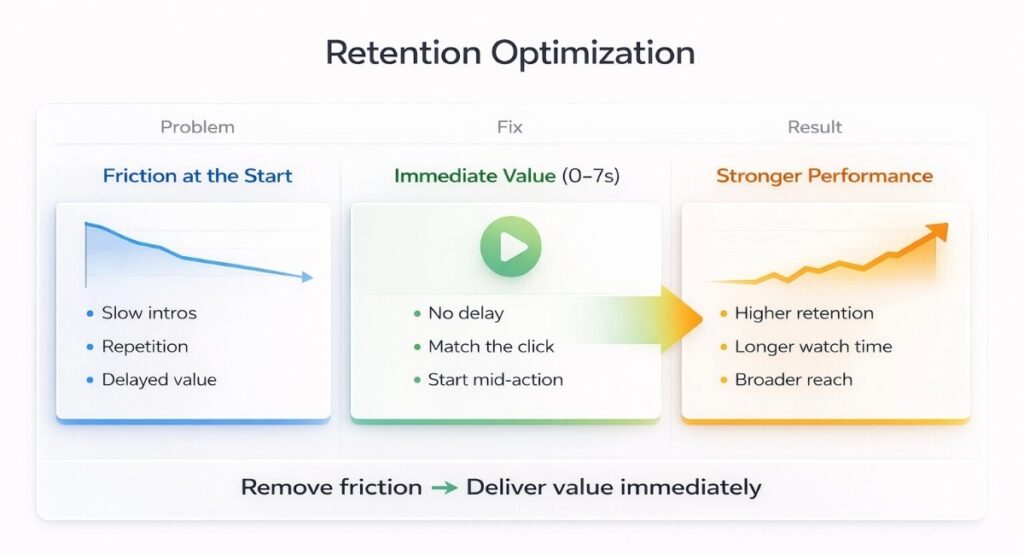
Most viewers decide whether or not to leave a YouTube video within the first few seconds. Not because your content is bad, but because something got in the way. Slow branded intros, repeated information, and vague openings create friction that kills retention before your message even lands. The fix isn’t complicated: remove what slows things down, lead with immediate value, and let your hook deliver on what your title already promised. Channels that apply these principles consistently see lower early drop-off, higher average view duration, and stronger algorithmic distribution.
Why Do Viewers Leave Videos in the First 5–10 Seconds?
YouTube is a time-based transaction. Viewers are giving you minutes of their day, and deciding almost instantly whether your content is worth watching. That first decision happens faster than most creators realise.
Pull up the retention graph on any video and you’ll almost always see a drop in the opening seconds. On high-performing channels, it’s a shallow dip. On channels that struggle with reach, it’s a cliff. YouTube picks up on those signals — and that difference shows up in watch time, satisfaction, and ultimately, reach.
When we look at what’s actually driving those early exits, the same patterns come up:
- The video doesn’t match the promise of the thumbnail and title
- The opening delivers context instead of value
- The pacing feels slow compared to the expectation set by the click
- The hook explains what’s coming instead of making the viewer care
What Does “Friction” Mean in a YouTube Video?
When we talk about friction, we’re referring to anything that slows the viewer down before the value actually starts. It’s the gap between what someone expected when they clicked and what they’re getting in those first few seconds. In editing terms, friction is often invisible — until you look at where people stop watching.
In most videos, it shows up like this:
Slow, Drawn-Out Intros
“Hey guys, welcome back to the channel” doesn’t give the viewer anything they didn’t already get from the click. Starting here burns the most valuable seconds of your entire video on pleasantries.
Logo Animations and Branded Bumpers
A five-second animated logo is five seconds of zero value to someone who hasn’t subscribed yet. There’s a case for short bumpers on established channels where audiences expect them — but even then, they’re a retention risk.
Repeating What the Title Already Said
If your title is “5 Things You Should Know Before Visiting Lisbon” and you open with “In today’s video, I’m going to cover five things you should know before visiting Lisbon” — you’ve just spent eight seconds saying nothing new. Your thumbnail and title already handled that job. Use those opening seconds to prove the video delivers on what you promised.
Lack of Immediate Value
This is the root of all friction. If a viewer can’t immediately sense what they’re going to get — a useful insight, an entertaining moment, a resolution to something — they’ll keep scrolling until another video shows them faster.
Multimodal Friction (What Most Videos Still Miss)
Friction isn’t just pacing; it’s about how your content is consumed. In 2026, most viewers are watching on mobile, often without sound. That changes what “clear” actually means.
- Two common gaps: No burned-in captions in the hook → viewers don’t immediately understand the value when muted
- Visuals that don’t reinforce the message → the viewer has to work to follow along
High-retention videos remove this friction by making the opening understandable with or without audio — combining strong visuals, fast clarity, and immediate context.
Why Are the First 2–7 Seconds So Critical for Retention?
On YouTube, viewers don’t wait for your video to start — they decide almost immediately whether it’s worth continuing. This is especially true for Shorts, where every second counts. But it applies just as much to long-form.
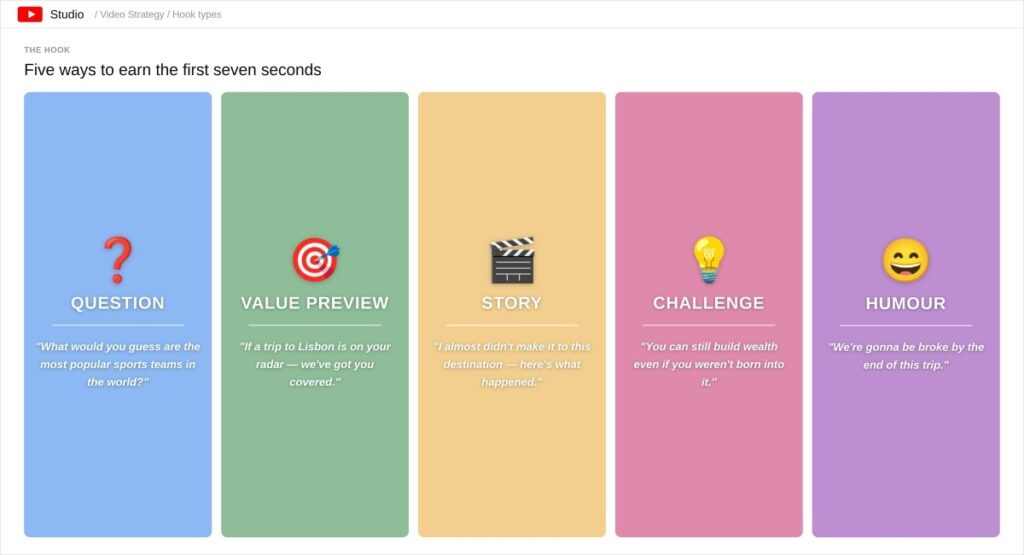
The hook — the opening moments that grab attention and set expectations — is the most important piece of your entire video. Spend as much time crafting those first few seconds as you do on the rest of the production.
A strong hook typically does one of five things: it opens with a question or provocative statement, previews the outcome, creates immediate stakes through story, challenges a common belief, or uses humour to pull the viewer in.
Pro Tip: Reinforce your hook visually. Use burned-in captions or on-screen text in the first few seconds so the value is clear even on mute — especially on mobile.
Hook Examples: What Holds Attention vs. What Loses It
| Strong Hook | Weak Hook |
| “These are the 10 things you don’t want to do when visiting Lisbon.” | “Lisbon is located on the Northern Peninsula of…” |
| “I don’t know about you, but I love taking personal videos and turning them into something that feels like it belongs in a movie.” | “Hey there folks, we’re going to present our visitor’s guide to Lisbon Portugal.” |
| [Cut to mid-action footage with cinematic music — value is immediate] | [Five-second logo animation — viewer waits for content to begin] |
| “You can still build wealth even if you weren’t born into it.” (challenges belief) | “In today’s video, I’ll cover five strategies for building wealth.” (restates title) |
Watch Out for Outdated Hook Patterns:
Some hook styles have become so overused that they now work against you. Fake reactions, over-acted shock cuts, and the “I can’t believe this happened” teaser that never pays off — audiences recognise these immediately, and they signal formula over substance. Authenticity will always land better than trend-chasing.
A direct, well-paced opening that delivers on your title’s promise will outperform a tired hook format every time.
Why Is What Used to Work on YouTube Not Working Anymore?
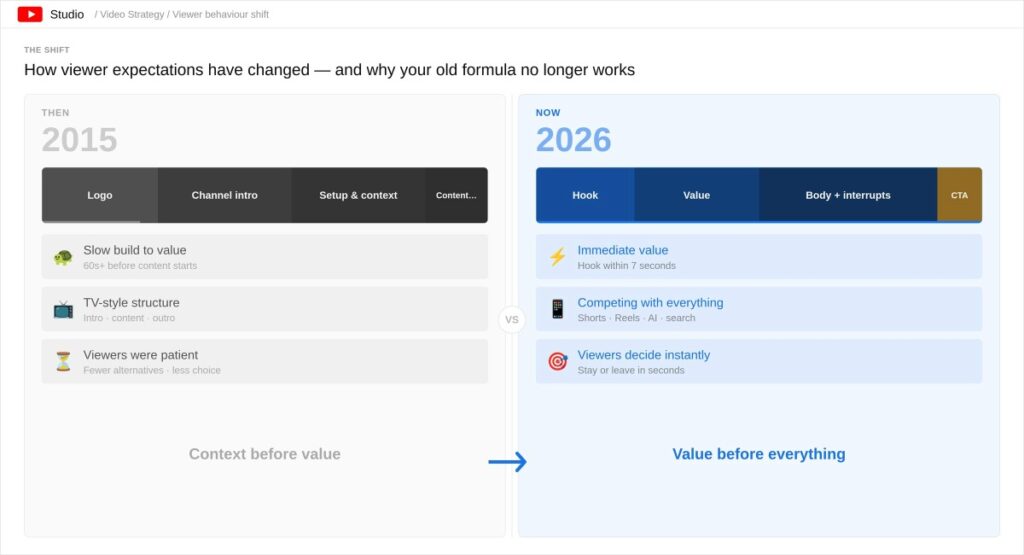
YouTube used to consist of more structured, slower videos. Intros were longer, context came first, and creators could ease into the content. This worked when viewers had fewer alternatives — but that environment doesn’t exist anymore.
Today, viewers are comparing your video against everything else available in real time — AI tools, short-form content, and years of conditioning from Shorts, Reels, and TikTok. They’re not settling in. They’re evaluating whether staying is worth it.
This isn’t about shorter attention spans. It’s about a higher standard. The bar for proving value has moved from “somewhere in this video” to “right now.”
Beyond the Hook
This shift affects the entire video. Viewers will leave the moment they feel they’ve gotten what they came for. That’s why structure matters — pattern interrupts, open loops, and continuous value delivery aren’t optional anymore. You’re not just earning the first thirty seconds, you’re re-earning every minute.
The same applies at the end. Outros almost always trigger a drop-off, so keep them tight. Your primary call-to-action should happen earlier, while attention is still high.
And none of this matters if the click never happens. Your thumbnail and title are held to the same standard — they need to earn attention instantly, or the video never gets the chance to retain it. YouTube thumbnail A/B testing is one of the most reliable ways to improve this.
What the Numbers Say
According to an internal analysis across 75+ YouTube niches and 10,000+ videos, Retention Rabbit found that 55%+ of viewer drop-off happens within the first minute. Videos that clearly communicate their value proposition within the first 15 seconds see 18% higher retention at the one-minute mark. The opening isn’t just important — it’s where most of your audience is already deciding whether to stay.
Do You Actually Need an Intro in YouTube Videos?
For most videos, not in the traditional sense.
This doesn’t mean removing branding altogether — it means repositioning it. Instead of leading with brand, high-performing videos introduce it after the viewer has already received value. Once trust is established, branding becomes reinforcement rather than friction.
Branded intros have historically played an important role — establishing who you are, setting the tone, and framing the content. But today, much of that context is already handled before the video even begins through your title, thumbnail, and channel presence.
By the time someone clicks play, they already have a sense of what to expect. From that first second, the priority shifts to delivering on the promise that earned the click.
When we look at retention graphs on videos with 5–10 second branded intros at the very start, the drop-off is consistent. When those intros are removed — and the video opens mid-action with a compelling visual, a clear statement, or a story already in motion — early retention tends to improve. It’s one of the clearest cause-and-effect relationships you’ll see in the data.
This is one of the core principles we apply within our video marketing services — using performance data to guide creative decisions. As viewing behaviour evolves, small adjustments in how a video starts can have an outsized impact on how long people stay.
The fastest way to improve your video often isn’t adding something new — it’s removing what’s getting in the way.
How Does Removing Friction Impact Audience Retention and Watch Time?
When early retention improves, performance tends to improve across the entire video.
When fewer people leave in the opening seconds, YouTube reads that as a strong signal that your video is worth watching. Videos that hold attention early are far more likely to be shown to a wider audience, while those with a steep early drop-off tend to lose reach quickly. It’s not just about views — it’s about whether people actually stay.
If you’re curious how YouTube fits into a broader SEO strategy, our YouTube SEO guide covers how video content contributes to visibility across both YouTube and Google.
Understanding the Retention Curve
The retention graph in YouTube Analytics shows you, second by second, how many viewers are still watching. A few key patterns to watch for:
- Early drop-off (0–15s): A sharp dip usually means the opening didn’t match the promise of the click
- Flat vs. gradual decline: Flat means strong engagement; a slow decline is normal — just keep it as steady as possible
- Rewatch spikes: If the line bumps up, viewers are going back — a clear sign something resonated
YouTube also summarizes this with Average Percentage Viewed (APV) — the share of your video the average viewer actually watches. As a simple benchmark, aim for around 50%+ on standard videos and 75%+ on Shorts. More important than hitting a number is improving your own baseline over time.
Engagement Velocity: Why It Matters
YouTube also looks at how quickly your video gains traction after it’s published.
This is called engagement velocity — how fast views, watch time, and interactions build in those first few hours. When a video performs well early, YouTube is more likely to recommend it more broadly.
And one of the easiest ways to improve that early momentum is by removing delays at the start — so viewers stay, engage, and keep watching.
What Does a High-Retention Video Structure Look Like?
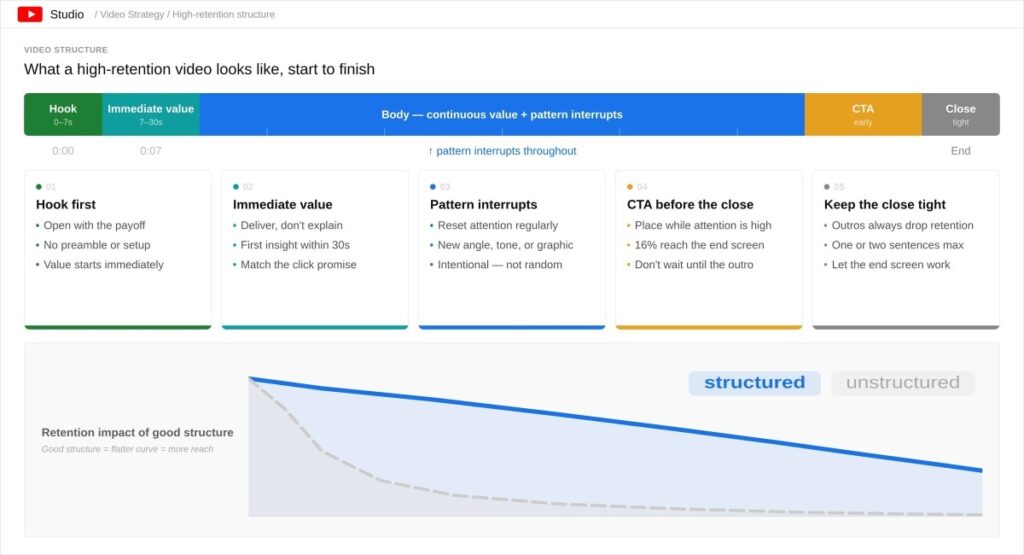
High-retention videos aren’t accidental — they’re built to keep people watching, one moment at a time.
1. Hook First — Always
Start with the value, not the setup. Whether it’s a striking visual, a bold statement, or a quick preview of what’s coming, your first few seconds should make the viewer feel like they’re already getting something — not waiting for it to begin.
2. Immediate Value Delivery
Don’t spend time explaining what you’re about to do — just start doing it. If your video is about the best restaurants in Lisbon, mention or show the first one before introducing yourself.
3. Pattern Interruption
Attention naturally drifts, so give it a reason to reset. Small shifts in visuals, pacing, or tone — a new angle, a graphic, a quick moment of humour — help re-engage the viewer and keep things moving. The key is intention: done well, these moments feel natural, not distracting.
4. Open Loops
Give the viewer a reason to stay. An open loop is simply a question or idea that hasn’t been answered yet — something that creates curiosity. For example: “In a minute, I’ll show you exactly where most videos lose 50% of their viewers.” Strong videos layer these moments throughout, creating a steady pull forward.
What Does the YouTube Retention Graph Actually Tell You?
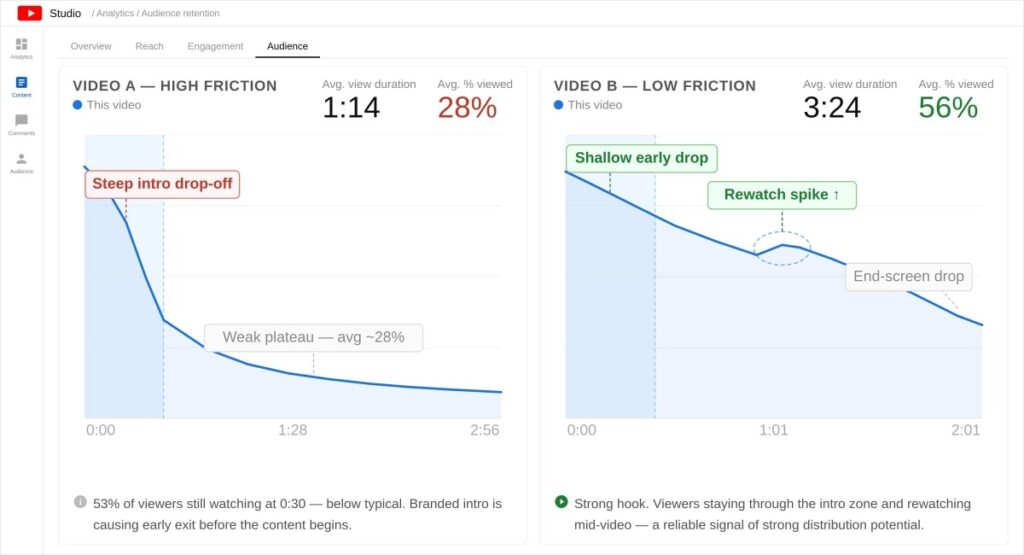
The retention graph is one of the most useful tools in YouTube Analytics — and one of the easiest to overlook.
Most creators check it once after publishing and move on. The channels that grow consistently use it as a feedback loop, learning from every video and applying those insights to the next one.
| What You See | What It Means |
| Steep drop in first 0–15s | Your opening didn’t match the promise of the click — viewers didn’t find what they expected quickly enough |
| Plateau from 15–60s | Viewers who made it past the opening are staying — your hook is doing its job |
| Gradual decline through body | Normal behaviour — the goal is to keep the drop as steady and gentle as possible |
| Sharp drop mid-video | A specific section is losing people — review the pacing or content at that moment |
| Rewatch spikes (bumps above baseline) | Viewers went back and watched again — something here stood out or delivered real value |
| Spike near the end | Your close or CTA is holding attention — end screens or final messaging are working |
YouTube’s Ask Studio tool (available to select creators), can now highlight drop-off moments and suggest areas to improve. It’s a helpful starting point after each upload before you dig into the graph yourself.
For a deeper breakdown of how YouTube defines moments like intros, spikes, and dips, the official YouTube retention documentation is worth bookmarking.
What Are Best Practices for Reducing Friction in YouTube Videos?
These aren’t one-time fixes. They’re practical habits that build momentum over time. Small adjustments here can often have the most noticeable impacts.
- Cut or reposition branded intros. Move branding after the viewer has already received value.
- Start mid-action. Open with something already happening — a result, a moment, or a visual that immediately pulls attention.
- Don’t repeat the title. Your viewer knows what the video is about. Use that opening time to start delivering on the promise instead.
- Match the click instantly. Whatever your thumbnail or title shows — bring it into the first few seconds.
- Tighten pacing throughout. Review and edit with the retention graph in mind. If something slows the viewer down, it’s probably costing you watch time.
- Test your openings. Just like thumbnails, different hooks perform differently. What works today may not work six months from now.
What Results Can You Expect from Retention Optimisation?
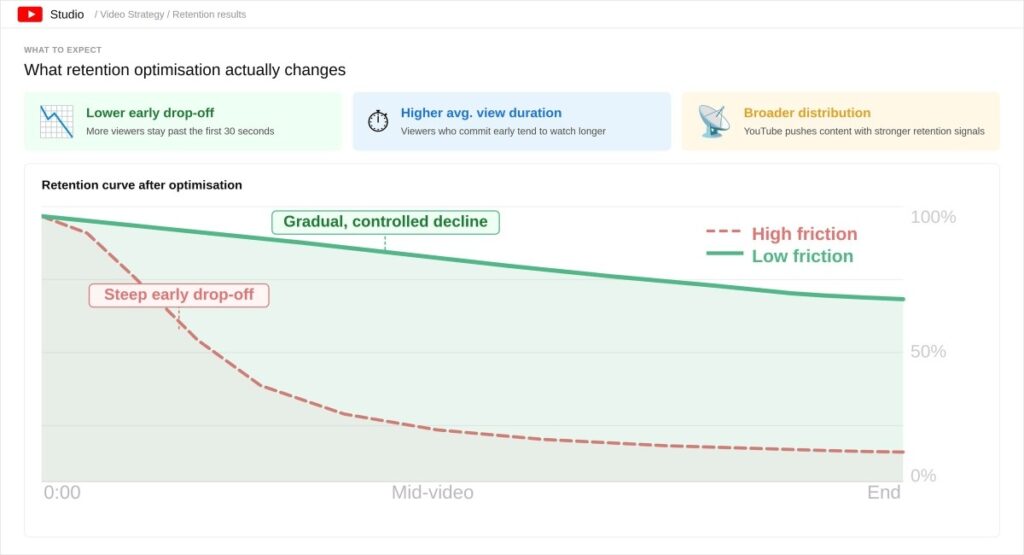
When friction is removed from your video, the impact tends to show up in three places:
- Lower early drop-off: More viewers stay past the first few seconds
- Higher average view duration: Watch time increases as people commit to the video
- Better distribution: Stronger performance signals lead to broader impressions
These improvements don’t come from a single change. They come from consistently refining how your videos start — and using retention data to guide what you adjust next.
YouTube’s creator blog offers a helpful breakdown of how retention fits alongside metrics like CTR and engagement in their guide to YouTube Analytics. It’s worth reviewing alongside your own Studio data.
What Is the Bigger Lesson About Retention and Video Strategy?
Retention isn’t just about editing — it’s about how people experience your video.
Every choice you make — where you start, what you leave out, how you pace it, when you shift tone — influences whether someone stays or leaves. The strongest channels aren’t just creating good content; they’re building experiences that make staying feel effortless.
Most brands treat YouTube as a production problem: how do we make better videos? The more useful question is: how do we make videos that hold attention? The answers are different — and the second one is what drives results.
Your analytics tab isn’t just a report card. It’s a feedback loop. It shows you what people actually do — where they stay, where they drop off, and what they rewatch.
The channels that grow consistently are the ones that close the loop between what they create and what the data tells them about how it landed.
That usually shows up in simple decisions:
- If a video is performing well, give it room to gain traction before posting again
- If viewers drop off early, study the timestamp before reaching for a solution
Over time, that discipline compounds. And in most cases, the gains don’t come from adding more — they come from refining what’s already there.
If you want to go deeper into content strategy and how search and video work together, our Learning Centre covers SEO, digital strategy, and the fundamentals behind how content earns visibility.
About the Author
Katie — Content & Video Editor, Blacksmith
Katie is a Content & Video Editor at Blacksmith who combines a strong creative eye with a performance-driven approach to video. She integrates SEO, AEO, and discoverability-focused strategy into every stage of production — from scripting and editing to packaging and publishing — ensuring content is not only visually compelling, but built to perform. Having worked across dozens of client channels in a wide range of industries, she specializes in turning creative ideas into high-quality, discoverable content.
Ready to Turn Your Video Content Into a Performance Asset?
Great videos don’t perform because they look better — they perform because every creative decision supports how the content is discovered, earns the click, and holds attention.
From the opening seconds to the final cut, pacing, structure, and delivery all shape whether someone keeps watching or leaves. That’s what turns good production into actual performance.
The channels that grow consistently are the ones that build around that idea — where editing, storytelling, and strategy are all aligned with how people actually watch.
At Blacksmith, we approach content through a performance lens — bringing SEO, video, and development together to build systems that drive results.
Explore how it all connects at https://blacksmithseo.com/
Frequently Asked Questions
What is a good YouTube audience retention rate?
There’s no single benchmark. Some sources suggest 50–75%, while broader data shows many videos sit closer to 30%. Both can be true depending on your niche and video length. The most useful benchmark is your own channel — focus on improving over time and use your top-performing videos to guide what works.
How long should a YouTube intro be in 2026?
For most videos, skip it entirely. Your title and thumbnail already set context — your opening should deliver value immediately. If needed, keep branding under 1–2 seconds max. Anything longer and you’re using up your most valuable retention window.
Does removing a branded intro actually improve retention?
Yes, consistently. Replacing intros with a direct hook or mid-action start improves early retention, which compounds into higher watch time and stronger distribution signals. The viewer isn’t waiting for the value anymore — it starts immediately.
What causes a spike in the YouTube retention graph?
A spike means viewers rewatched that moment. It’s a clear signal something resonated — these are the moments worth analysing and repeating in future videos.
Is audience retention the most important YouTube metric?
It’s one of the most important, but it works alongside CTR, watch time, and engagement. Strong retention with low CTR usually points to a thumbnail or title issue. Performance comes from balanced signals — not optimising one metric in isolation.
What is engagement velocity on YouTube?
Engagement velocity is how quickly a video gains views, watch time, and interactions after publishing. Strong early momentum increases the likelihood of broader distribution. Posting when your audience is most active (visible in YouTube Analytics) can help support this.
Can AI tools help improve YouTube retention?
Yes, especially for identifying drop-off points and performance patterns. Tools like YouTube’s Ask Studio can highlight where viewers leave and suggest improvements. They’re most effective when paired with a clear strategy, helping you act faster on what your data is already showing.
