
Last updated: May 13, 2026
Freshness affects two channels at once: Google’s organic rankings and AI search citations. Google’s Query Deserves Freshness (QDF) signal class evaluates recency at the query level, not the page level, boosting newer content only for searches where users expect recent information. AI search platforms now cite content that is 25.7% fresher than organic Google results, per an Ahrefs analysis of 16.975 million citations across seven platforms.
Matching your update cadence to the freshness window of each query type is the difference between earning a ranking boost and triggering Google’s fake-freshness detection. This guide covers the mechanisms: how QDF works, what the 2025 and 2026 core updates changed, and what the Gemini 3 model swap means for the AI citation strategy. For the implementation side, read the freshness calendar implementation guide. that acts on this knowledge.
Key Takeaways
- Freshness is query-level, not page-level. QDF only triggers for queries where users expect recent information. Evergreen content does not benefit from the same update cadence as trending topics or annual comparisons.
- Google detects fake freshness. The December 2025 core update penalizes superficial date changes without substantive content improvements. The March 2026 core update continued the same trajectory with even greater ranking volatility.
- AI search amplifies the freshness advantage. ChatGPT cites URLs 393 days newer than organic results. Perplexity draws roughly 50% of citations from current-year content.
- Gemini 3 decoupled organic rankings from AI citations. The January 2026 model swap retired 42% of previously cited domains from AI Overviews and collapsed the overlap between top-10 organic rankings and AI Overview citations from 76% to as low as 17%.
- The 13-week AI citation window. AirOps data shows 35.2% of AI-cited pages were updated within the last three months. Pages not updated within 13 weeks lose citation priority on competitive topics.
What is Query Deserves Freshness?
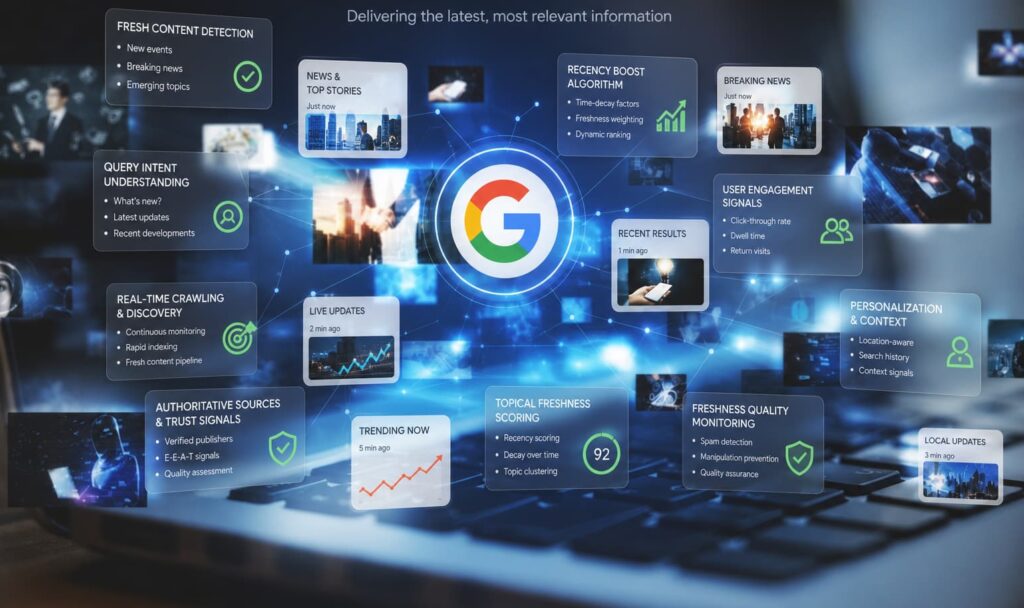
Query Deserves Freshness (QDF) is a signal class within Google’s ranking systems that identifies queries where users expect recent information and temporarily boosts newer content. QDF operates at the query level — freshness matters for some searches and is irrelevant for others.
Google’s documentation describes freshness systems as “designed to show fresher content for queries where it would be expected.” A search for “earthquake Los Angeles” after a seismic event triggers QDF. A search for “what causes earthquakes” does not.
Google engineer Amit Singhal introduced QDF around 2007, and Google formalized the broader freshness algorithm in its November 2011 “Freshness Update,” which Google itself reported as impacting approximately 35% of all searches at launch. The system monitors three signals: news volume (are outlets actively covering this topic?), blog and forum activity (are creators discussing it?), and search volume spikes (is there a sudden increase in queries?). When these signals align, Google temporarily boosts newer content.
Detection speed is near-instant. QDF is not just about having recent content — it is about having content ready to publish or update when a topic becomes time-sensitive.
Which queries trigger freshness and which do not?
Freshness triggers for breaking news, trending topics, annual comparisons, and any search where users explicitly expect recent information. It does not trigger for definitional queries, historical content, or stable reference material. Understanding which category your target queries fall into determines how you schedule updates.
Freshness triggers for breaking news, trending topics, annual comparisons, and any search where users explicitly expect recent information. It does not trigger for definitional queries, historical content, or stable reference material.
| Query type | Freshness sensitivity | Update cadence |
| Breaking news / current events | High (QDF active) | Publish within hours |
| “Best of” / annual comparisons | High (seasonal QDF) | Every 6 to 12 months |
| Rapidly evolving topics (AI, regulatory) | High (indirect QDF) | Quarterly |
| Technical how-tos (evolving tools) | Medium (product-triggered) | When the tool changes |
| Industry analysis / trend pieces | Medium | Every 6 months |
| Definitional / educational | Low (QDF does not trigger) | Annual review |
| Historical / reference | None | Only if facts change |
The grey zone deserves attention. A query like “how to set up Google Analytics” does not trigger QDF from news spikes, but the content still needs updating because the product has changed. This is relevance decay, not freshness decay. Freshness decay requires regular updates matched to a QDF window. Relevance decay requires substantive content improvement regardless of timing.
For the practical system for categorizing your URLs by decay type and building update schedules around them, read the editorial calendar freshness guide.
Content designed to resist both forms of decay follows an Evergreen content strategy that focuses on building around concepts rather than current tools, extending the useful life of a page without requiring constant freshness updates.
How did the December 2025 core update change freshness?
Google’s December 2025 core update refined freshness evaluation by targeting superficial date manipulation. Sites that change Last Updated timestamps without meaningful content improvements now face ranking demotion for recency-sensitive queries.
What counts as substantive: new data points from current research, additional sections addressing recent developments, refreshed methodology reflecting current best practices, and original analysis not in the previous version.
What does not count: changing the publish date, adding a sentence, swapping one statistic, or reformatting without adding information.
The old playbook of bumping dates quarterly without meaningful work is now counterproductive. In our experience auditing client content libraries through Q1 2026, the sites that lost the most ground after the December update were the ones with the cleanest-looking Last Updated calendars and the thinnest underlying revisions.
What about the March 2026 core update?
The March 2026 core update continued this trajectory, surpassing December as the most volatile on record. Per SE Ranking’s analysis, only 20.5% of top-three URLs held their exact position, down from 33.1% in December, and roughly one in four pages in the top 10 fell out of the top 100 entirely. For content teams, the signal is clear: substantive updates now carry more weight than at any point in Google’s history.
How does freshness affect AI search visibility?
AI search platforms show a measurable preference for fresher content, creating a second channel where freshness affects visibility independently of Google rankings. Per Ahrefs’ analysis of 16.975 million citations across seven platforms, AI-cited content is 25.7% fresher than organic Google results.
The average age of AI-cited URLs is 1,064 days (roughly 2.9 years), compared with 1,432 days (roughly 3.9 years) for organic results. ChatGPT shows the strongest freshness preference, citing URLs 393 days newer than organic results in its in-text references (and 458 days newer in its formal citations). Perplexity draws approximately 50% of its citations from current-year content, and per Seer Interactive’s analysis of 5,000+ URLs, 65% of AI bot hits target content published within the past year. Both platforms show a positive correlation between citation order and content age: newer content gets cited first.
One important caveat: the average cited content is still 2.9 years old. AI platforms still prefer authoritative, long-lived content. Freshness is a factor, not the dominant factor. For competitive topics with multiple authoritative sources, freshness becomes the tiebreaker.
What changed with Gemini 3 and AI Overviews
Google rolled out Gemini 3 as the default AI Overviews model on January 27, 2026. The model change retired roughly 42% of previously cited domains from AI Overviews and now pulls 31.8% more sources per response — from an average of 11.55 sources before Gemini 3 to 15.22 after.
The overlap between AI Overview citations and top-10 organic rankings collapsed from roughly 76% in mid-2025 to between 17% and 38% (per Ahrefs) by early 2026. Ranking well in organic results no longer guarantees AI Overview visibility, and freshness alone can now earn citations that an organic position does not.
For content teams, this decoupling changes the strategic calculus. Brands updating core content monthly see meaningfully higher AI coverage than those with stale content, per Frase’s Gemini 3 recovery analysis. A page can climb in Gemini-3-powered AI Overviews the same week it slides in organic rankings, and vice versa.
Before January 2026, Google AI Overviews cited content that was, on average, 16 days older than organic results — favouring established authoritative sources over recency. That dynamic has shifted post-Gemini 3. The freshness premium now extends to AI Overviews for competitive topics in a way it previously did not.
Does publish frequency affect crawl budget?
Publish frequency interacts with crawl budget through a feedback loop. Google’s crawl demand follows two signals: page popularity and content staleness. When both align, crawl frequency increases.
Google defines staleness as the system’s desire to “recrawl documents frequently enough to pick up any changes.” Popularity means “URLs that are more popular on the Internet tend to be crawled more often.” When a page is both popular and regularly updated, Google discovers updates faster, indexes them sooner, and reflects them in rankings more quickly.
This creates a structural speed advantage for sites with active editorial calendars. Pages that Google already crawls frequently show ranking improvements from updates faster than pages that sit idle.
Per GenOptima’s 2026 GEO playbook, new content enters AI citation pools within three to five business days of publication, and content older than 14 days without freshness updates begins losing citation priority. The crawl and freshness feedback loop now connects directly to AI visibility, not just organic rank.
Important caveat from Google’s documentation: crawl budget is not a concern for most publishers. If new pages get crawled the same day they go live, crawl budget is not a constraint. This primarily matters for large sites with thousands of URLs.
For smaller publishers: update consistently, and Google will notice. Monitoring GA4 traffic sources confirms whether crawl and indexing patterns respond to your update schedule.
How to Build an Editorial Calendar Around Freshness
Translating freshness signals into an editorial calendar requires organizing your content schedule around update windows, not publishing frequency. The core system: categorize every URL by freshness sensitivity, assign review dates by content type, apply the 3:1 publish-to-update ratio, and use Search Console CTR signals and Google Trends to time updates before QDF windows open.
For the complete step-by-step system — including how to apply the 13-week AI citation window, how to prioritize updates by traffic potential, and what a three-track editorial calendar looks like in practice — read How to Build an Editorial Calendar Around Content Freshness.
Frequently asked questions
What is Query Deserves Freshness (QDF)?
Query Deserves Freshness is a signal class in Google’s ranking systems that identifies queries where users expect recent information. Google monitors news volume, blog activity, and search volume spikes to determine when fresher content should rank higher for a specific query.
Does Google rank fresh content higher?
Only for queries where users expect recent information. Freshness is query-level, not universal, so breaking news, trending topics, and annual comparisons trigger QDF while definitional content and stable reference material do not benefit from freshness alone.
What did the December 2025 core update change about freshness?
The December 2025 core update introduced penalties for superficial date changes without substantive content improvements. Sites that update timestamps without adding new data, new sections, or refreshed analysis now face ranking demotion on recency-sensitive queries. The March 2026 core update continued the same direction with greater overall ranking volatility..
How does Gemini 3 affect content freshness strategy?
Gemini 3’s deployment as the default AI Overviews model in January 2026 decoupled organic rankings from AI Overview citation. The overlap between top-10 organic results and AI Overview citations collapsed from 76% to between 17% and 38%. Fresh content can now earn AI citations that a high organic ranking does not guarantee, making freshness management a dual-channel concern rather than a purely organic one.
How does content freshness affect AI search visibility?
AI platforms cite content that is 25.7% fresher than organic Google results, and ChatGPT shows the strongest preference, citing URLs 393 days newer on average. Since January 2026, Gemini 3 powers AI Overviews and has retired roughly 42.4% of previously cited domains across 100,000 tracked keywords.
How does Google’s QDF signal work?
Query Deserves Freshness monitors three signals: news volume, blog and forum activity, and search volume spikes. When these align, Google temporarily boosts newer content for that query. QDF operates at the query level — it triggers for some searches and is irrelevant for others.
Freshness is not about publishing more. It is about updating strategically, matching your cadence to the queries that reward recency and leaving evergreen content alone until it needs attention. If your editorial calendar treats every page the same, it is working against you, and building a freshness-aware content program starts with knowing which queries demand it. That conversation starts here.
Speakable passages:
“Freshness affects two channels at once: Google’s organic rankings and AI search citations. Google’s Query Deserves Freshness signal class evaluates recency at the query level, not the page level, boosting newer content only for searches where users expect recent information.”
“Google rolled out Gemini 3 as the default AI Overviews model on January 27, 2026. SE Ranking’s 100,000-keyword study found the new model replaced approximately 42% of previously cited domains and pulls 32% more sources per response.”
“AirOps tracked more than 4,000 pages and found 35.2% of AI-cited pages updated in the last three months, with 53.4% updated within six months. For competitive topics, any page older than 13 weeks without a substantive update is losing citation priority.”
About this playbook
Primary sources: Ahrefs’ 17-million-citation freshness study (Ryan Law, July 28, 2025); SE Ranking’s Gemini 3 impact study (Yulia Deda, February 26, 2026, 100,000 keywords); SE Ranking’s March 2026 vs December 2025 core update analysis; ALM Corp’s AI Overview citation drop analysis; the AirOps 2026 State of AI Search report (Oshen Davidson, December 2, 2025). Secondary sources: Frase.io’s Gemini 3 recovery playbook; Seer Interactive’s content recency research; GenOptima’s 2026 GEO playbook; HubSpot’s historical-blog-optimization case study; Search Engine Land’s QDF guide.
