
Google’s helpful content system was deprecated in March 2024, absorbed into core ranking systems that now evaluate helpfulness continuously through multiple interacting signals — not a single periodic classifier. Sites penalized under the original system did not automatically recover when it was retired, because those penalty signals became part of the core ranking itself.
Most affected sites have seen only partial recovery at best. Full traffic restoration remains rare. This is not another algorithm tweak. It is a structural change in how Google defines ‘helpful’, and it affects how content teams plan audits, prioritize rewrites, and measure recovery.
Key Takeaways
- The classifier is gone, but the signals remain. Google retired the standalone HCU in March 2024 and distributed helpfulness evaluation across core ranking systems.
- Evaluation shifted from periodic to continuous. Content quality is now assessed in real time, not during scheduled update rollouts.
- Page-level scoring replaced site-wide classification. Individual pages can rank on their own merit, even on sites with mixed-quality content elsewhere.
- Recovery is partial for most affected sites. The majority of HCU-affected sites have not fully recovered. Meaningful traffic improvement remains the exception.
- Helpfulness is now a reward signal, not just a penalty. Sites demonstrating original research, first-hand testing, and strong E-E-A-T alignment gain a ranking advantage.
What Actually Replaced the Helpful Content System?
When Google deprecated the HCS in March 2024, they described it as being “incorporated” into core ranking. In practice, a single periodic site-wide classifier was replaced by multiple systems that run simultaneously on every query, evaluating helpfulness at the page and passage levels rather than issuing a sitewide verdict. The mechanics matter here, and most coverage glossed over them.
The old HCS was a smoke detector. It triggered when something was wrong, and you knew where the problem was. The new system is a fire-resistant structure. It doesn’t trigger. Either the content is built right, or it isn’t. There’s no alarm to reset.
The structural change is worth making explicit.
| Old HCS (2022–March 2024) | Core Integration (March 2024+) | |
|---|---|---|
| Architecture | Single classifier | Multiple distributed systems |
| Scope | Site-wide signal | Page-level and passage-level |
| Timing | Periodic batch run | Continuous, per-query |
| Recovery path | Wait for the next HCU run | Satisfy multiple core systems simultaneously |
| Penalty type | Binary threshold — whole site | Granular per-page and per-passage scoring |
Google’s Search Liaison put it directly: the HCS is now part of a core ranking system that assesses helpfulness across all aspects where the keyword is “aspects.” Not a single pass. Not a single score. Not a single reversal.
Why Sites Penalized Under the Old System Are Still Not Recovering
A Lily Ray/Amsive analysis of 671 travel publisher sites found that 32% of them lost more than 90% of their organic traffic during the HCU period. Two years later, most haven’t come back.
What’s missing is simpler but harder to accept: there is no longer a single unlock. Under the old system, the path was legible: identify unhelpful content, improve it, then wait for the batch run. A sequence with a finish line.
Under the new system, recovery requires satisfying multiple interacting signals simultaneously. The December 2025 update solidified this reality: Google is no longer testing whether your site has been patched. It continuously verifies that your content better matches specific passage-level intent than the competition’s.
In practice, sites that saw gains did so by spending the year engineering their content to become the definitive, intent-aligned source for their niche, and not by waiting for a helpfulness reassessment event.
The View from the Trenches: In our internal audits following the December 2025 data, we stopped seeing “algorithmic punishment” and started seeing “relevance gaps.” The sites that saw gains in December were the ones that spent the year engineering their content to become the definitive, intent-aligned source for their niche.
For context on how core systems interact behind the scenes, our blog explaining search algorithms covers the components now directing these assessments.
Not your thing? That’s okay tool. Work with a team that lives and breathes this, so you don’t have to.
What ‘Helpful’ Actually Means in Google’s Infrastructure Today
Helpfulness in Google’s current systems is not a score or a label. It is a continuous, multi-signal assessment applied at the page and passage level for every search query. This changes what it means to optimize for it in ways most post-HCU content advice hasn’t caught up to.
From site-wide to passage-specific. The old HCS flagged sites with significant unhelpful content and applied a site-wide penalty. The new system can reward a properly structured passage on an otherwise average-performing page. A March 2025 Ahrefs study of 863,000 keywords found that only 38% of AI Overview citations came from pages ranking in the top 10 for the same query, with citations split almost evenly between positions 11–100 and beyond position 100. A helpful passage on a page ranking 8th can win citations that a thin page ranking 2nd cannot.
E-E-A-T is now about falsifiability. The question is no longer whether you claim experience, but whether your content demonstrates that the person writing it actually did the thing they’re writing about. Demonstrated experience can’t be replicated by someone who wasn’t there. That’s what Google’s systems are trained to detect.
Information Gain is the only road forward.
Google’s systems assess the marginal value a page adds relative to everything else already indexed. A page that restates what competitors are already saying contributes zero value. Original framing, proprietary data, or unique synthesis is the only thing that registers as genuinely useful.
The Three Spam Policies Define What ‘Helpful’ Means Now
Google launched three new spam policies alongside the March 2024 core update. Most coverage treated them as separate news items. They’re not separate. Read together, they’re the clearest definition Google has ever published of what helpfulness is not, and therefore what it is.
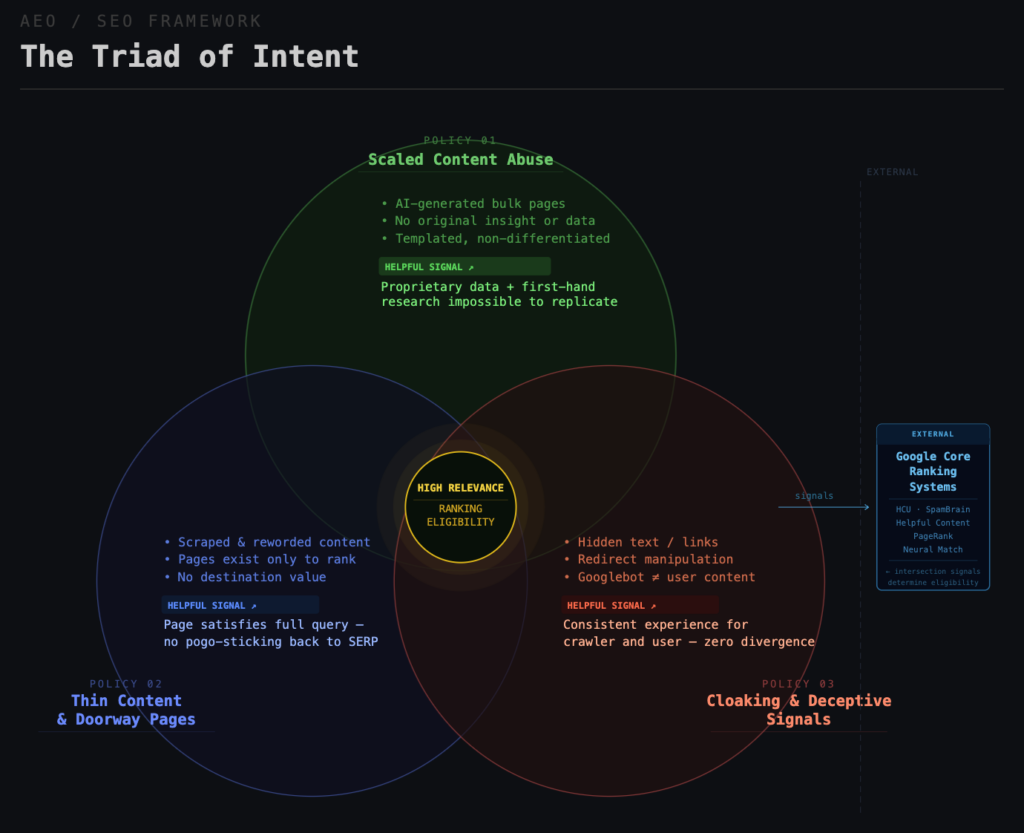
1. Scaled Content Abuse targets mass production of content, by humans or AI, with the primary intent of manipulating rankings. Google isn’t penalizing volume. They’re penalizing intent. Helpfulness is now defined by process and purpose, not output volume.
2. Site Reputation Abuse, what the industry calls parasite SEO, targets third-party content published on trusted domains to borrow authority that the content didn’t earn. The manual penalties that followed in May 2024 hit CNN, Forbes, and USA Today, with entire site sections de-indexed for hosting affiliate or editorial content that didn’t match the domain’s primary expertise.
Helpfulness is context-specific. A well-written coupon roundup on a news domain isn’t helpful. It’s misaligned.
3. Expired Domain Abuse targets buying domains with historical authority and hosting low-quality content on them. Helpfulness requires trust signals built via consistent, relevant, original activity. They cannot be purchased or inherited.
The through-line across all three: using a shortcut to appear authoritative without actually being helpful. Scale abuse, reputation abuse, and inherited authority: three routes to the same fraud.
What Recovery Actually Looks Like in 2026
Recovery is possible but partial for most affected sites. Full recovery to pre-HCU traffic levels remains rare. Planning around realistic benchmarks produces better outcomes than chasing full traffic restoration, the data doesn’t support.
Sites that regain traffic typically recover around 30–33% of their original sessions — a figure Glenn Gabe has documented across multiple recovery cycles. The contrarian read: that recovered traffic tends to be higher-intent and higher-converting than the keyword-targeted traffic that was lost. For sites measured by conversions rather than raw sessions, 33% of old traffic at a double-engagement rate is a net gain.
Recovery timelines are consistent: first signals typically appear four to five months after substantive content changes. Most practitioners recommend planning a six-to-twelve-month audit-and-rewrite cycle before expecting measurable results. The depth of changes matters more than the time elapsed.
The honest answer to ‘my traffic dropped, and I don’t know why’: in many cases, it dropped because the old system tolerated content that the new one does not. Recovery requires building something the new system actively rewards, not restoring what the old system used to allow.
How to Adapt Your Content Strategy
The shift from periodic penalty to continuous evaluation means content strategy must operate as an ongoing quality system, not a one-time optimization pass. Four structural commitments define what the new system rewards:
- Audit first. Remove or rewrite thin content before publishing new material.
- Build content that competitors can’t replicate. Original data, hands-on testing, documented client results, and specific practitioner insight are the strongest differentiators.
- Strengthen E-E-A-T signals structurally. Author bios need verifiable credentials and topical context. Topical authority builds through depth on specific subjects, not breadth across unrelated ones. These signals are assessed on every crawl.
- Shift from keyword coverage to query-specific depth. Five deep articles that answer specific queries with original insight outrank twenty thin how-tos targeting keyword variations. Every section should exist to answer a real question, not satisfy a word count.
Information Gain: The Only Road Forward
This is the practical application of Information Gain. Google’s systems assess the marginal value a page adds relative to everything else already indexed. A page that restates what competitors are already saying contributes zero value; a page that provides original framing, proprietary data, or unique synthesis is the only one that registers as genuinely useful.
To operationalize this, we follow four structural commitments:
- Direct Answers: Every section opens with a complete answer before expanding.
- Demonstrable Experience: First-hand analysis is included in every claim, making the content “falsifiable”—it cannot be replicated by someone who didn’t actually do the work.
- Data as Evidence: Sources confirm particular data points rather than acting as decorative filler.
- Intent-Driven Sections: Every section exists to answer a real question, not to satisfy a word count.
This structural approach is a direct requirement for AI Overviews. AI answer engines perform a “live test” of Information Gain on every query; they select the source that provides the clearest, most credible answer.
Is your content architecture built for 2026, or is it still waiting for a 2022-era HCU signal?
The HCS is retired. The standard it was enforcing isn’t. Search has shifted from a keyword-matching game to a test of Information Gain on every query. If your content isn’t built to answer specific passages better than the competition, you aren’t just invisible, but obsolete. At Blacksmith SEO, we help brands move beyond the “ranking” game by building content that engines trust.
Stop guessing what Google wants. Let’s look at the data.
Frequently Asked Questions
What replaced the Google Helpful Content Update?
The Google Helpful Content Update no longer exists as a standalone update type. Starting with the March 2024 core update, helpfulness assessment was integrated directly into Google’s core ranking systems. Multiple systems now evaluate content helpfulness continuously on every query, rather than in periodic isolated passes.
Is the Helpful Content System still a separate signal in 2026?
No. Google officially retired the Helpful Content System as a distinct classifier in March 2024. What replaced it is a distributed set of assessments embedded across core ranking systems that run continuously. There is no longer a single ‘helpful content score’ that can be isolated, targeted, or reversed independently.
Can a site recover from an HCU penalty in 2026?
Recovery is possible but no longer follows the pre-2024 playbook. The old path was: improve content, wait for the next HCU batch run. That mechanism doesn’t exist. Recovery now means satisfying multiple interacting core ranking signals through consistently helpful, experience-driven, passage-structured content built over time.
How does Google determine if content is helpful now?
Google uses multiple core ranking systems to assess helpfulness at the page and passage level on every search query. Key signals include E-E-A-T, Information Gain relative to competing content, passage-level answer completeness, and alignment between the content’s intent and the domain’s established topical authority. Helpfulness is a product of how all of them interact.
