
Quick Summary:
YouTube SEO in 2026 is about more than just ranking on YouTube. It’s about showing up everywhere your audience is searching — from Google AI Overviews, where video is increasingly prominent, to AI-driven tools like Bing Copilot and, in some contexts, ChatGPT Search. YouTube is the world’s second-largest search engine, with around 2.6 billion monthly active users worldwide — and in 2026, its influence extends far beyond its own platform. A well-optimised video now drives traffic across multiple surfaces at once. This guide breaks down how to rank YouTube videos in 2026 using a practical, system-level approach — from titles and thumbnails to AI-era structured data, retention strategy, and Shorts — built around what actually moves the needle today.
What Is YouTube SEO, and Why Does It Matter More in 2026?
YouTube SEO is the process of optimising video content to increase visibility across YouTube, Google search results, and AI-driven search platforms. In 2026, it spans multiple surfaces — one well-optimised video can earn placement on YouTube, Google Video, Google AI Overviews, and occasionally within other AI-driven search tools.
YouTube has always been a powerful organic channel. What’s changed is where that visibility shows up. Today, AI search engines don’t just link to content — they pull key information from it, summarise it, and present it directly in the answer. Google’s AI Overviews and Bing Copilot often cite YouTube when video data provides the best answer to a user’s query.
That means a well-optimised video can now show up in places your blog post may never reach. For the informational and how-to queries your audience is searching every day, video is often competing for — and winning — the same space as written content. Focus on one without the other, and you limit your visibility.
What Does Video Do for Your Website Beyond YouTube?
This is where things start to get interesting. Embedding video on your website isn’t just a nice addition — it’s a real, measurable SEO lever. Here’s what it can unlock:
- Increased dwell time and lower bounce rates: When visitors watch a video, they stay longer. That can improve engagement metrics like time on page, which often correlates with stronger performance in search results.
- Higher click-through rates in search: Pages with video snippets may see higher CTRs depending on query type and thumbnail visibility
- VideoObject schema for richer visibility: Adding VideoObject schema helps search engines understand your video, which may improve eligibility for rich results and AI Overviews in Search.
- A built-in audience for retargeting: Viewers who engage with your videos can be retargeted through Google’s ad network, helping reduce acquisition costs over time.
- Cross-platform discovery from one asset: A single video on a page can appear in YouTube search, Google Video, and suggested content — offering multiple discovery paths from a single piece of content.
Video also plays a role beyond search. Embedded content can support email campaigns, landing pages, and conversion funnels — helping turn traffic into measurable business outcomes.
How Does the YouTube Algorithm Work in 2026?
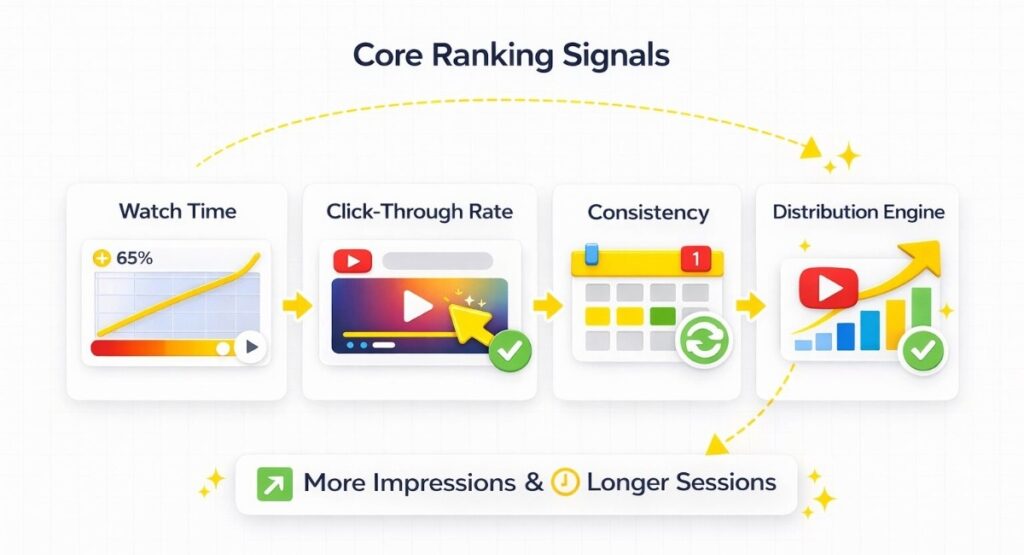
YouTube’s algorithm recommends content based on three core signals: watch time and retention, click-through rate (CTR) from titles and thumbnails, and content consistency. In 2026, YouTube’s AI-driven features (like Ask Studio) also provides insights on early traction.
If you want to understand YouTube, this is the key idea: it’s a time-based platform. It earns revenue from ads, and ads rely on attention. Everything YouTube does — from recommendations to autoplay — is designed to keep people watching. That’s the lens behind every decision the algorithm makes.
At a high level, YouTube SEO comes down to three things: choosing the right topic, earning the click, and holding attention. Most channels don’t struggle with production — they struggle with choosing the right topics and structuring videos to hold attention.
YouTube also looks at what happens after your video ends. Content that leads viewers to watch another video — either on your channel or across the platform — tends to be promoted more heavily. Keeping people in a viewing session is a key part of how the algorithm evaluates value.
There are three core signals driving those decisions. Get these right, and YouTube does a lot of the distribution work for you.
1. Watch Time and Audience Retention
Of the three signals, retention is often what separates channels that grow from those that stall. Retention rate — the percentage of your video viewers actually watch — tells YouTube whether your content delivers on its promise.
Both relative watch time (percentage watched) and total watch time matter. A video that holds 60% of viewers to the end will usually outperform a longer video with lower retention.
Practical takeaways:
- Hook the first 10 seconds — get straight into value
- Cut filler — every moment should move things forward
- Use open loops — give viewers a reason to stay
- Add pattern interrupts — visual changes help maintain attention
For a deeper look at how to reduce the friction points that kill retention — from pacing and structure to hook design — see our guide to YouTube Retention Optimization.
2. Click-Through Rate (CTR) from Titles and Thumbnails
YouTube tracks how often your video is shown — and how often people click it. A strong CTR signals that your title and thumbnail are doing their job, which leads to more distribution.
For thumbnails, the fundamentals still matter: high contrast, minimal text (three to five words), and visuals that complement the title rather than repeat it. Faces with authentic expressions tend to perform especially well and draw attention in a crowded feed.
If you can, A/B testing is definitely worth doing. Small changes in layout, wording, or expression can noticeably impact performance. Our guide to YouTube thumbnail and title A/B testing breaks down the full process — including how YouTube selects a winner based on watch time share, not just CTR.
For titles, it comes down to balance. You’re writing for two audiences: the person scrolling who needs a reason to click, and the algorithm that needs a clear topic signal. Keep titles between 50 and 70 characters, front-load your keyword and value, and avoid generic, keyword-only phrasing. Clarity gets you indexed, but curiosity earns the click.
3. Content Consistency and Upload Cadence
YouTube’s algorithm rewards predictability over volume. Publishing one strong video per week will almost always outperform inconsistent bursts of content. Consistency signals that your channel is active, and it also helps your audience know what to expect.
Long-term consistency beats short-term intensity every time, so make sure to build a schedule you can actually maintain.
Pro tip: When a video is performing well, resist the urge to publish again right away. Let it breathe. YouTube’s recommendation system needs a little time to understand how viewers are responding before you shift attention to the next upload.
How Do You Optimise a YouTube Video for Search in 2026?
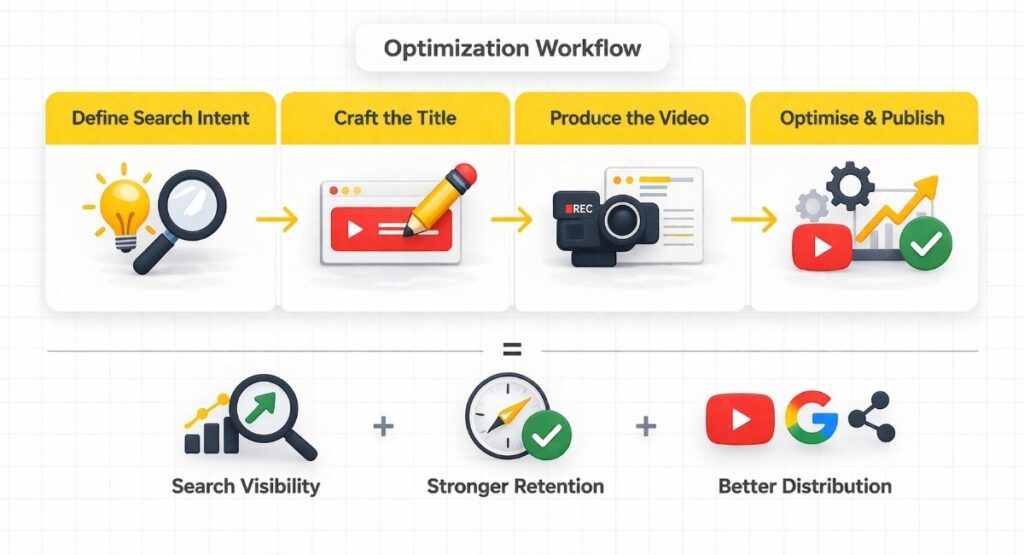
To optimise a YouTube video effectively, you need a clear YouTube SEO strategy — not just individual tactics. Focus on strong titles, clear thumbnails, well-written descriptions, and accurate transcripts. Each element plays a role in helping both viewers and search systems understand your content.
Not all optimisation elements carry equal weight. Titles and thumbnails drive clicks, retention drives distribution, and descriptions and tags provide supporting context.
Titles
Here’s a simple but powerful shift: start with search intent before you write your title. What is someone actually typing into YouTube — and what format best answers it? Tutorials, comparisons, and “how-to” videos perform best when the format aligns directly with the query.
A simple way to validate a topic is to check YouTube autocomplete and search results. If you see consistent phrasing and multiple videos performing well, it’s a strong signal of real search demand. Your title isn’t just a label — it defines what the video needs to deliver. When you get this right first, everything else becomes easier to align.
The goal is to balance two things: intrigue (why should someone click right now?) and search relevance (what people are actually typing). A useful formula to test is: [Curiosity hook] + [Core keyword] + [Implied outcome].
For example, “48 Mistakes to Avoid When Growing a YouTube Channel (From Someone Who Made Them)” will almost always outperform something like “YouTube Growth Tips 2026.” One creates curiosity — the other just states the topic.
Descriptions
Your description is prime SEO real estate that most channels underuse. Write it as a human-first paragraph, and include your primary keyword within the first 150 characters — that’s the portion visible before the fold.
From there, add a clear call to action, chapter timestamps (which YouTube surfaces in search results to improve both CTR and navigation), and relevant links to other videos or your website.
Use your description strategically by linking to related videos or playlists. This helps guide viewers to what to watch next — increasing session time and strengthening your overall channel performance.
Tags are now a very minor signal for discoverability — largely deprecated — but they can still help with misspellings or uncommon variations of keywords.
Captions and Transcripts
YouTube auto-generates captions — but they’re not always accurate. Editing them gives you a clean, fully indexed transcript, making your video searchable at the word level.
This is where voiceover matters. Spoken content creates rich, keyword-relevant transcripts that give search and answer engines far more context. Burned-in on-screen text alone isn’t reliably indexed, so if it isn’t said out loud, it’s far less likely to be picked up from a search perspective.
Accurate captions also improve accessibility and help extend watch time in sound-off environments like commutes, offices, or public spaces.
How Does YouTube SEO Connect to Google AI Overviews and AI Search?
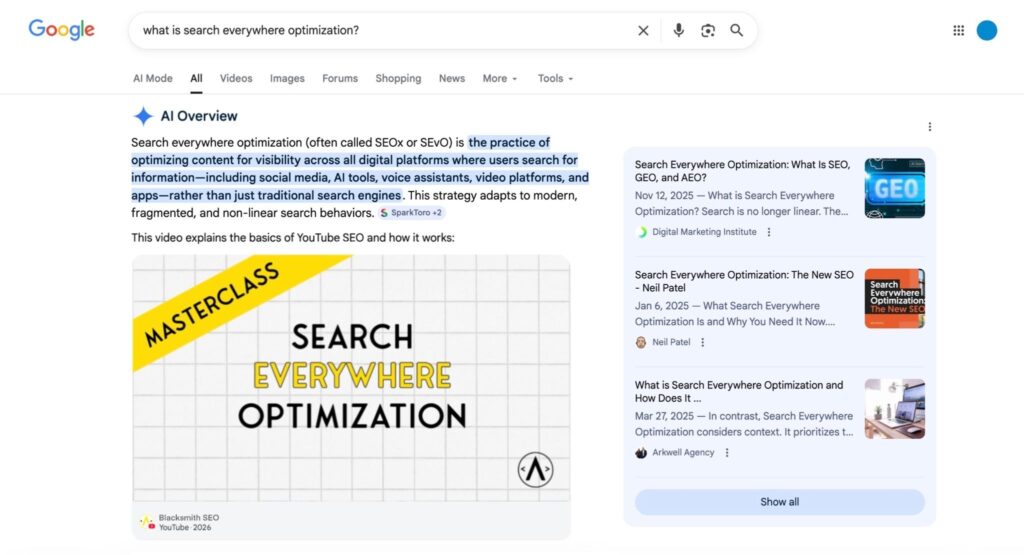
Google’s AI Overviews and AI Mode often include YouTube videos into AI-generated answers when relevant. And while selection features have not been publicly disclosed, ensuring the video content is clear, trustworthy, and closely aligned with what someone is searching for can increase your chances of being featured.
Videos with strong titles, accurate transcripts, VideoObject schema on the page they’re embedded on, and solid engagement are most likely candidates for inclusion.
Ranking on YouTube is still important — but it’s no longer the full picture. The bigger opportunity now is showing up inside AI-generated answers: the summaries and citations users see before they even scroll. That’s where attention is shifting, and where well-structured video content can have the biggest impact. If you want to see how this fits into the bigger strategy, our guide to Search Everywhere Optimisation breaks it down further.
Here’s what helps your videos get there:
- Clear, easy-to-follow transcripts: Structured video transcripts can improve discoverability, especially for AI systems that process video metadata. If your script includes direct, self-contained answers to common questions, those moments are far more likely to be pulled into AI-generated results. It’s worth writing your video scripts with this in mind.
- VideoObject schema on your website: When you embed a video on your site and add VideoObject schema, you’re giving search engines clear context about what that video covers. It connects the page and the video in a way that’s easy for AI systems to understand — and increases your chances of showing up in video results and AI Overviews.
- Strong engagement signals: Watch time, click-through rate, and comments all help signal that your content is valuable. The stronger these signals are, the more likely your video is to be surfaced — both on YouTube and in AI-driven search experiences.
- Visibility across multiple search surfaces: A single well-optimised video can appear in several places at once — standard search results, video results, thumbnails in image search, and AI Overviews. That kind of visibility is hard to achieve with text alone.
What Is Ask YouTube and What Does It Mean for Your SEO?
Ask YouTube is a new conversational search experience built directly into YouTube. Instead of typing a keyword and getting a list of results, users can ask complex questions — and follow-up questions — and receive a structured, interactive response compiled from across YouTube’s full catalogue.
That’s a meaningfully different discovery surface from YouTube’s standard search, and it has two practical implications worth paying attention to.
First, Ask YouTube pulls from both long-form videos and Shorts in the same response. If you’ve been treating Shorts purely as a reach tool and long-form as your search play, that distinction matters less here. A Short that clearly answers part of a query can appear alongside a long-form tutorial in the same compiled result.
Second, conversational queries are more complex than keyword searches. Someone asking “what’s the best way to teach a beginner guitar player chord transitions without frustrating them” isn’t typing a keyword — they’re describing a specific situation. Videos that answer questions directly, in plain language, with clear structure, are better positioned to surface in this kind of search than videos optimised purely around a single keyword phrase.
The same fundamentals that help with AI Overviews apply here: accurate transcripts, clear descriptions, and video scripts that include self-contained, direct answers to real questions. If you write your scripts with a specific question in mind and answer it clearly in the first minute, those moments are more likely to be pulled into structured results.
Ask YouTube is currently available to YouTube Premium members aged 18 and up in the US, with a broader rollout to all users planned.
The key takeaway:
Think of every YouTube video as more than just a YouTube asset. When it’s properly optimised and supported on your website, it becomes a powerful search asset too — helping you show up wherever people are searching in 2026.
While AI visibility is expanding, YouTube search remains one of the most consistent traffic sources for evergreen content. Videos that target clear, repeatable queries can continue driving views long after publication.
Should You Use YouTube Shorts as Part of Your SEO Strategy?
Yes. YouTube Shorts (vertical videos under 60 seconds) can help new channels grow by tapping into YouTube’s dedicated Shorts feed, while also helping established channels reach new audiences more consistently. While shorts and long-form videos operate on separate algorithms, Shorts can help grow your audience, which indirectly benefits long-form reach.
That separation still holds for YouTube’s recommendation engine, but YouTube’s new Ask YouTube search surface (covered below) surfaces Shorts and long-form together in the same structured response, so format is no longer a hard boundary for discovery via conversational search.
Shorts have earned their place in a strong YouTube strategy — not as a replacement for long-form content, but as a complementary tool. Where long-form videos are typically discovered through search intent, Shorts are served based on behaviour. In other words, YouTube shows them to people likely to enjoy them, not just people actively searching. That makes Shorts especially effective for reach, particularly when you’re still building an audience.
A few practical tips to get started:
- Repurpose long-form content into Shorts. A single 10-minute video often contains multiple standalone insights — each one can become its own Short.
- Focus on your opening frame, not the thumbnail. Shorts autoplay in the feed, so performance is primarily driven by the first few seconds.
- Treat Shorts as an entry point. The goal is to attract new viewers, build familiarity, and guide them toward your long-form content.
- Gemini Omni: now built into Shorts Remix and the YouTube Create app — gives you a more capable version of this. You can remix an eligible Short using a text prompt to change the scene, visual style, or aesthetic, while the model keeps the original video’s context intact. For teams without dedicated video resources, it’s a practical way to produce more content without starting from scratch. One thing worth knowing if you’re working with client content: Shorts remixed through Omni carry digital watermarks and identifying metadata, and link back to the source video automatically.resources.
What Are the Best Content Types for YouTube Channel Growth?
The most effective YouTube content formats include educational tutorials, vlogs or documentary-style videos, product reviews, interviews, and listicle videos. For most business channels, educational and listicle formats tend to perform best in search because they directly match how-to and informational intent.
A strong YouTube strategy doesn’t try to do everything — it focuses on the right mix. For most businesses, that means building a foundation of evergreen content (tutorials, FAQs, and guides that stay relevant over time), supported by more timely or trend-based content that drives short-term visibility.
Evergreen vs. Trending Content
| Content Type | Lifespan | Discovery Mechanism | Best Use |
| Evergreen (tutorials, FAQs) | Months to years | YouTube Search, Google Video, AI Overviews | Build long-term authority |
| Trending (news, seasonal) | Days to weeks | Homepage feed, Shorts | Drive short-term growth |
| Shorts | Variable | Shorts feed, Discover | Reach new audiences |
| Interviews / podcasts | Months | Search, referrals | Build credibility |
One small but important production tip: for evergreen videos, keep time-sensitive details (like years or dates) in your title and thumbnail — not in the video itself. That way, you can update positioning later without the content feeling outdated. It’s a simple habit that can extend the lifespan of your videos significantly.
For businesses producing content consistently, having a structured production approach becomes just as important as the strategy itself. Whether it’s evergreen guides, property showcases, or brand-focused videos, the goal is to create content that’s both high-quality and built to perform. If you want to see how that looks in practice, explore our approach to video production.
How Does YouTube Studio’s AI Help You Make Better Content Decisions?
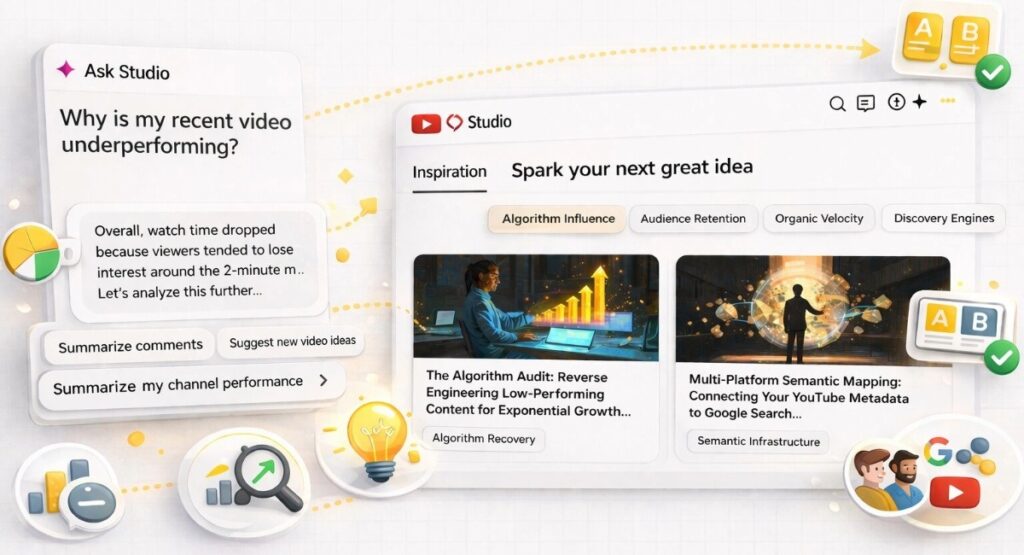
YouTube Studio’s AI tools — especially the Ask Studio chatbot — make it much easier to understand what’s working and why. Instead of manually digging through reports, you can now ask direct questions about performance, audience behaviour, or content ideas and get clear, data-backed answers in seconds.
If you’ve used YouTube Studio recently, you’ve probably noticed how much it’s evolved. The addition of built-in AI has shifted it from a reporting tool to something much closer to a decision-support system.
Instead of piecing together data from multiple dashboards, you can now ask things like: “Why did this video underperform?” or “What are viewers responding to most in my recent uploads?”
— and get useful, actionable insights right away.
Here’s what’s available (to select channels and regions) as of early 2026:
- Ask Studio chatbot: Natural-language access to analytics, including retention, traffic sources, and audience feedback.
- Audience segmentation: Viewers grouped into Regular, Casual, and New — helping you understand loyalty vs reach.
- Title and thumbnail A/B testing: Test 2-3 variations and let YouTube optimise based on watch time performance, not just clicks.
- Inspiration Tab: AI-generated content ideas based on your audience and niche trends.
- Auto-dubbing: Expands your reach by translating and dubbing videos into additional languages.
- Collaborations: Add multiple creators to a single video to expand distribution across audiences.
Availability of these features can vary by channel, region, and eligibility level, as many are still being rolled out across YouTube Studio. Beyond individual features, one of the most important patterns to watch is how a video performs shortly after publishing. Strong early click-through rate, watch time, and retention can significantly influence how widely YouTube distributes your content.
How Do You Build and Engage a YouTube Community That Grows Your Channel?
Channel growth really accelerates when viewers become active participants — people who comment, share, and come back for every upload. The most effective way to build that is through consistent, genuine engagement.
A helpful way to think about it: the strength of a YouTube channel isn’t just in its subscriber count — it’s in how engaged those subscribers are. A smaller, highly active audience will often outperform a larger passive one.
Building that engagement comes down to how you show up:
- Respond to comments, especially in the first 48 hours after posting
- Use the Community tab between uploads to stay visible
- Pin a comment that invites a specific response
- Bring viewer questions into future videos (and credit them)
- Collaborate with channels that share your audience, not just your size
The shift is simple: treat your audience less like viewers, and more like collaborators.
Is YouTube SEO Worth the Investment for Your Business?
For most businesses — especially those targeting informational or how-to searches — YouTube SEO offers long-term value that paid advertising simply can’t match. A well-optimised video can continue generating traffic for months or even years after it’s published. When combined with VideoObject schema on your website, it also strengthens your search visibility and builds a retargeting audience for future campaigns.
The real advantage comes down to a few key factors:
- Compounding value: Unlike paid advertising — which stops generating traffic the moment your budget stops — a well-optimised video keeps earning views and clicks for months, sometimes years, after it’s published.
- Increased visibility: One video can rank on YouTube, Google Video, Google AI Overviews, and in AI chat tools simultaneously. That’s four distribution surfaces from a single asset.
- Trust and engagement: Video is one of the highest-trust content formats available at scale. A viewer who spends several minutes watching your content is far more likely to convert.
The goal isn’t one great video — it’s building a repeatable system that consistently produces content that performs. That said, it’s important to be realistic. YouTube SEO takes time and consistency. Most channels start seeing meaningful traction after six to twelve months of steady publishing. It’s a long-term strategy, best suited for businesses focused on building lasting authority, not quick wins.
Ready to Build a YouTube SEO System That Works in 2026?
YouTube SEO today isn’t just about rankings — it’s about visibility across an entire search ecosystem. The videos that perform best aren’t just well-produced; they’re intentionally structured. They match search intent, hold attention, and are produced in a way both people and search systems can understand.
When those pieces come together, video becomes more than just content — it becomes a powerful driver of traffic, trust, and long-term growth.
At Blacksmith, we take that same approach — combining production, SEO, and distribution strategy to create content that doesn’t just look good, but performs.
If you’re ready to maximise your reach with a more strategic approach to video, contact Blacksmith to discuss your video SEO strategy and start turning consistent views into meaningful business results based on your audience and goals!
Frequently Asked Questions
How long does it take for a YouTube video to rank?
Most videos begin receiving initial distribution within the first 24 to 72 hours of upload. Early performance — including click-through rate, watch time, and retention — plays a major role in how widely a video is promoted. Search-driven visibility, where a video appears consistently for specific queries, typically develops over several weeks depending on competition and engagement. Evergreen topics with lower competition can gain traction quickly, while more competitive queries may take longer to establish.
Does YouTube SEO affect Google rankings?
Yes, in two key ways. First, YouTube videos can appear directly in Google’s video results and sometimes within AI-generated answers for relevant queries. Second, embedding a YouTube video on your website and adding VideoObject schema improves that page’s eligibility for video results and AI-driven visibility — which can support overall search performance.
What is the ideal video length for YouTube SEO?
There isn’t a fixed ideal length — the goal is to cover your topic thoroughly while keeping viewers watching. Retention matters more than duration. That said, videos between 8 and 15 minutes often perform well for educational and how-to content, as they generate meaningful watch time without overwhelming the viewer. Short-form videos (under 60 seconds) operate on a separate discovery surface and are best used to complement long-form content.
How important are YouTube tags in 2026?
Tags are largely deprecated for discoverability — they play a minimal role today — but can still help with misspellings or rare alternate keyword variations. Focus your optimisation efforts where they matter most: title and thumbnail first, retention and watch time second, and metadata like descriptions and tags as supporting context.
What is Ask YouTube, and how should I optimize for it?
Ask YouTube is a conversational search feature that lets users ask complex, multi-part questions and receive a structured response compiled from across YouTube’s catalogue — including both long-form videos and Shorts. It launched for YouTube Premium members in the US in 2026, with a broader rollout planned.
From an optimisation standpoint, the fundamentals don’t change, but emphasis shifts. Transcripts, descriptions, and clear in-video answers to specific questions become more important, because Ask YouTube is matching against intent, not just keywords. Videos that address a clear question directly — particularly in the first minute — are better candidates for inclusion than videos that circle around a topic. Shorts are now in play here too, so well-structured short-form content isn’t just a reach tool anymore; it’s a search asset on this surface.
Can a small business compete on YouTube without a big production budget?
Absolutely. On YouTube, strategy and consistency outperform high production value in most business niches. A clear topic, strong structure, and the ability to hold attention will outperform a high-budget video built around the wrong idea. Start with a cadence you can sustain, and focus on creating content that aligns with real search demand. Production quality can improve over time as your channel matures.
