
Answer-First Summary
Perplexity is transforming how marketers discover insights and how audiences find brands, but how does it stack when you compare Perplexity vs Google?
With over 780 million monthly queries processed and a $20 billion valuation in 2025, this AI-powered answer engine represents a fundamental shift from link-based search to direct, conversational responses.
For marketing leaders and SEO strategists, Perplexity isn’t replacing Google, but it is definitely reshaping the visibility landscape. Success now requires Answer Engine Optimization (AEO): structuring content for AI extraction, earning citations across answer engines, and building authority that language models trust. Brands that adapt their content strategy for this AI-native search behaviour will forge stronger connections with audiences who increasingly expect immediate, synthesised answers.
The future of digital marketing belongs to those who understand that visibility in 2026 means being the answer, not just a link.
But First, What is Perplexity AI and Why Should You Care?
Perplexity AI is an AI-powered answer engine that delivers conversational, cited responses instead of link lists, processing 780 million monthly queries and representing how 22 million active users now search for information without traditional click-through behaviour.
The search landscape you built your marketing strategy around is evolving rapidly. While Google remains dominant, a parallel ecosystem of AI-powered answer engines is capturing meaningful audience attention—and changing how people discover brands.
Perplexity AI sits at the centre of this transformation. Unlike traditional search engines that present ranked lists of links, Perplexity synthesises information from multiple sources and delivers direct answers with inline citations. For the marketing leader evaluating where to invest resources, this matters because in May 2025, Perplexity processed 780 million search queries, tripling its volume from just one year earlier.
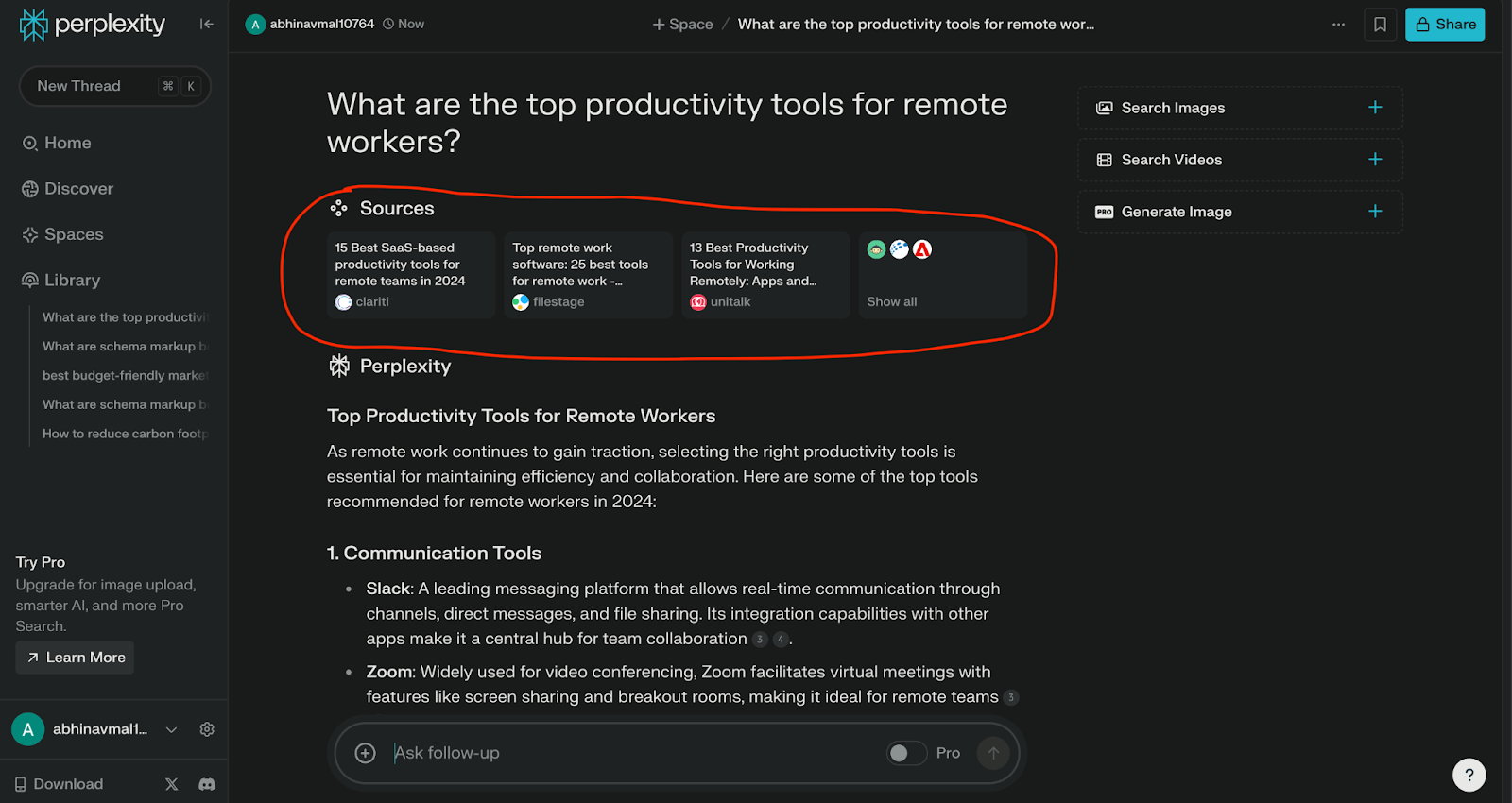
The platform reached a $20 billion valuation in 2025, with 22 million active users worldwide and $100 million in annual recurring revenue. These aren’t vanity metrics—they represent a growing segment of your audience that’s adopting new search behaviour. Nearly 48% of marketing leaders have invested in AI tools like Perplexity to enhance their teams’ effectiveness.
This shift creates both challenge and opportunity. When users get their answers directly from AI without clicking through to your website, traditional traffic metrics become less meaningful. Yet brands that understand how to optimise for answer engines can achieve something more valuable: becoming the authoritative source that AI platforms cite and trust.
The question isn’t whether AI search will impact your marketing strategy. It’s whether you’ll adapt your content approach before your competitors do.
Tailoring Content to Match Search Intent
Understanding your customers’ search intent is key to effective SEO, and Perplexity AI excels at identifying and addressing these needs. By analyzing queries holistically, Perplexity delivers answers that resonate with user expectations.
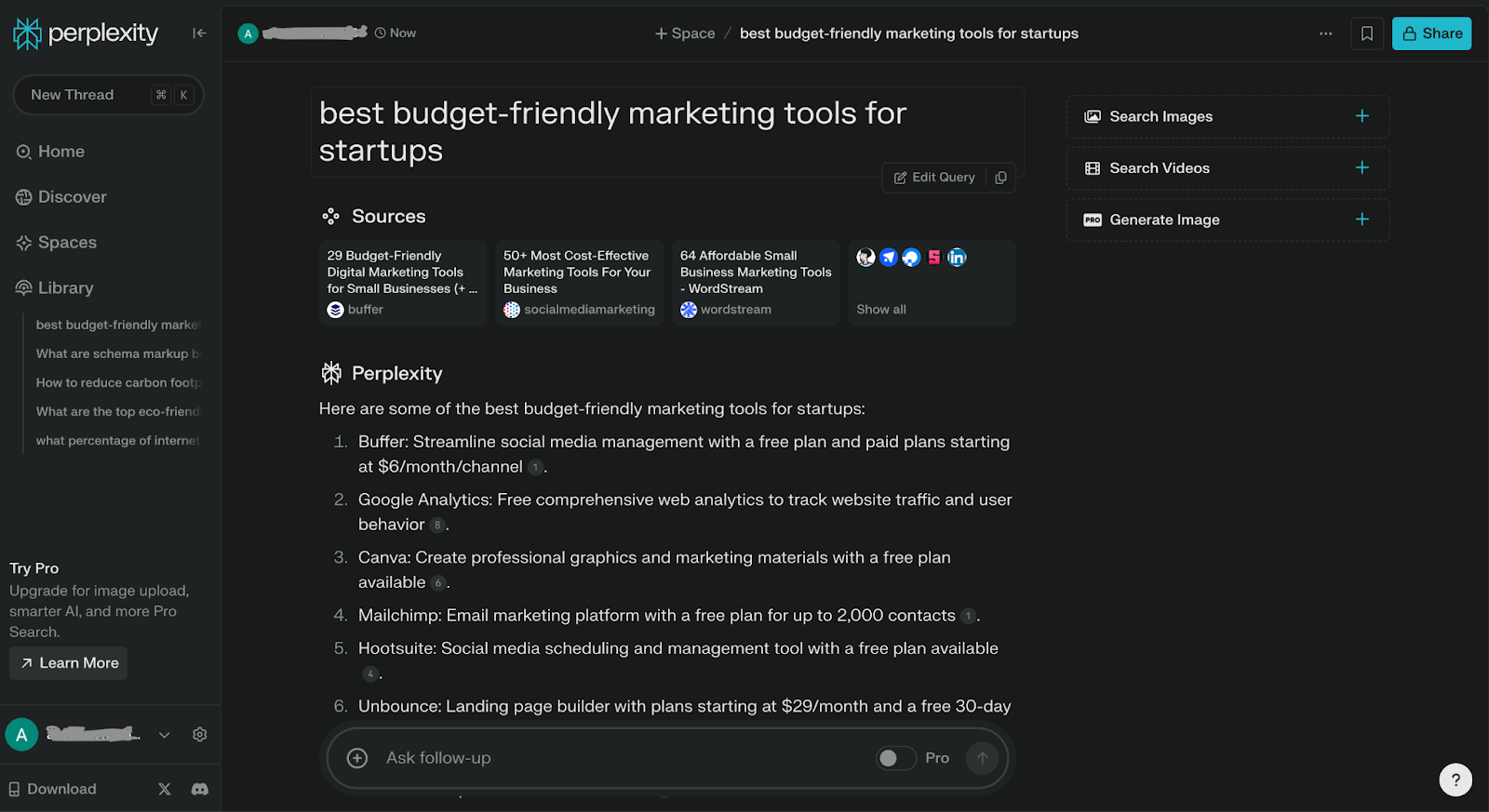
For instance, when a user searches for “best budget-friendly marketing tools for startups,” Perplexity doesn’t just match keywords. It identifies entities (“marketing tools” and “startups”) and attributes (“budget-friendly”), delivering precise recommendations. SMBs can replicate this strategy by creating content that addresses specific pain points and offers actionable solutions.
Perplexity vs. Google: How Does Perplexity Compare to Google
Perplexity complements rather than replaces Google by serving quick-answer queries with conversational depth, while Google excels at comprehensive research, local discovery, and broad exploration—smart marketers optimise for both platforms simultaneously.
Your audience isn’t choosing between Google and Perplexity. They’re using both, but for different reasons.
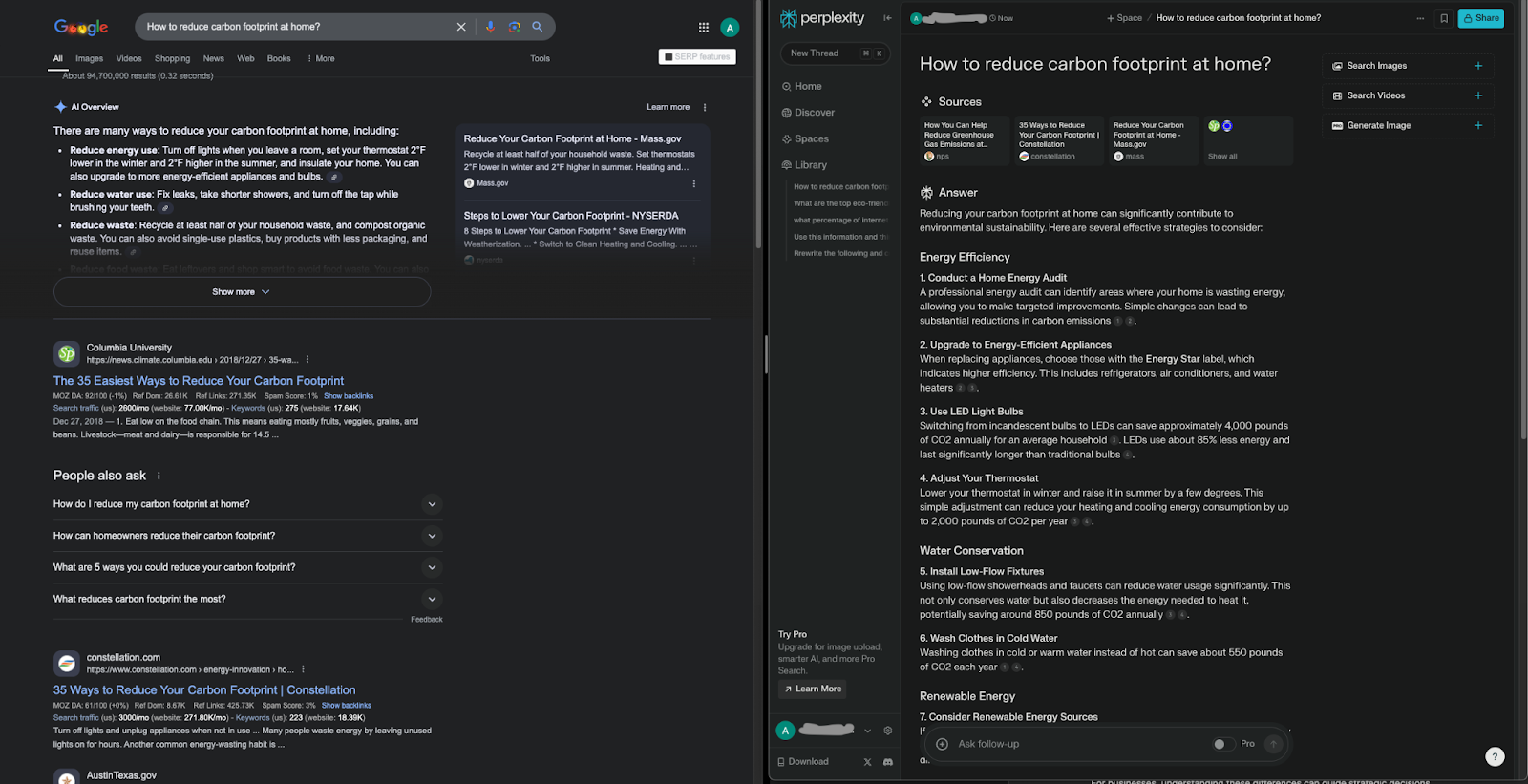
Google remains unmatched for broad exploratory searches, local business discovery, and shopping journeys that require comparing multiple options. Google processes 8.5 billion searches daily and its ecosystem of Maps, Shopping, and AI Overviews creates a comprehensive experience Perplexity doesn’t attempt to replicate.
Perplexity excels at something different: answering specific questions with conversational depth and cited sources. When someone asks “How do marketing attribution models compare in B2B SaaS?” or “What’s the latest data on email open rates in 2025?”, Perplexity delivers synthesised answers that might take 15 minutes of Google research to compile manually.
The strategic insight: these platforms serve different moments in your customer’s journey. Google captures early exploration and intent-rich searches. Perplexity addresses the “I need to understand this quickly” moment—often during work hours when decisions need research-backed answers fast.
Consider how your audience’s search behaviour splits:
- Perplexity usage peaks during working hours when professionals need quick, authoritative answers
- 62% of Perplexity traffic comes from mobile, indicating on-the-go information needs
- Average session lasts significantly longer than traditional search engines, suggesting deeper engagement with synthesised content
For your content strategy, this means creating assets that serve both ecosystems. Comprehensive guides and product pages optimised for Google’s ranking signals. Concise, structured content with clear answers that AI engines can extract and cite.Concise, structured content with clear answers that AI engines can extract and cite.
The future isn’t either/or, it’s knowing which platform your content should prioritise for which customer questions.
While Google remains the dominant player in search, Perplexity AI offers unique advantages for businesses. Here’s a quick comparison:
| Feature | Perplexity AI | |
| Search Methodology | Comprehensive algorithms | Precise, conversational focus |
| Personalization | Advanced, behaviour-based | Minimal, focused |
| Interface | Rich, multifaceted | Streamlined, minimalist |
Understanding these differences can guide strategic decisions. Google excels in breadth and depth, while Perplexity’s streamlined design caters to transactional and quick-answer scenarios.
What Is Answer Engine Optimization (AEO) and Why Does It Matter for Your 2026 Strategy?
Direct Answer: Answer Engine Optimization (AEO) structures content so AI platforms can extract, cite, and present your expertise in zero-click answers—critical because organic traffic is predicted to decline 25% by 2026 as users get answers without visiting websites.
Traditional SEO taught us to rank pages. Answer Engine Optimization requires thinking differently: getting cited inside the answer itself.
When someone asks ChatGPT, Perplexity, or Google’s AI Overview a question, these systems synthesise responses from multiple sources—and those sources earn visibility without a single click to their website. According to SparkToro research, organic link clicks declined by 4% from March 2024 to March 2025, while zero-click searches rose by 3%.
This isn’t a distant trend. It’s reshaping how your target audience discovers information right now. Over 60% of Millennials and Gen Zers already use AI engines in their search routines, and that percentage is climbing month over month.
AEO demands three fundamental shifts in how you approach content:
Build Consensus Across Channels
AI engines look for agreement across multiple credible sources before citing something as fact. When your messaging, data points, and positioning remain consistent across your website, guest articles, press mentions, and social content, you build the consensus signals that language models trust. This means coordinating your content across owned and earned media—ensuring the same statistics, frameworks, and perspectives appear wherever your brand shows up.
Provide Information Gain
AI platforms prioritise content that offers unique insights, original research, or fresh perspectives that don’t merely repeat what’s already widely known. Publishing proprietary data, conducting original research, or presenting established concepts through new frameworks increases your citation likelihood. Information gain means contributing something genuinely new to the conversation.
Structure for Extraction
Language models thrive on clarity. Use question-based headings, include comparison tables, write in short paragraphs with topic sentences, and implement schema markup that signals what information means. According to Forrester’s 2025 AEO research, structured data and clear semantic hierarchy directly impact whether AI platforms can extract and cite your content accurately.
The hard truth: AEO often generates fewer direct website visits than traditional SEO. But it creates something potentially more valuable—authoritative presence at the moment someone forms their understanding of a topic. When your brand consistently appears as the cited source in AI-generated answers, you’re not just building traffic. You’re building trust at scale.
Preparing for the Future of Generative SEO
Generative Engine Optimization (GEO) is reshaping SEO, and businesses must adapt to thrive across platforms:
- Stay Updated on Trends: Follow developments in AI-driven search and adapt your strategies accordingly.
- Invest in Local SEO: Optimize for location-based searches to attract nearby customers. This strategy is especially valuable if you want to invest in SEO for a small business.
- Leverage Multimedia Content: Use videos, infographics, and audio to engage audiences across multiple formats.
THE 2026 HORIZON: What Marketing Leaders Need to Prepare for Now
Why 2026 Represents an Inflexion Point for AI Search and Digital Marketing
Direct Answer: By 2026, Semrush predicts AI search visitors will surpass traditional search visitors by 2028, with Perplexity projected to triple its market share and AI agents beginning to execute purchases autonomously—requiring marketers to fundamentally rethink visibility strategies, content formats, and attribution models before competitive advantages calcify.
We’re not discussing distant possibilities. The transition is already underway, and 2026 marks the year when early adopters’ advantages become nearly insurmountable.
The urgency stems from how competitive advantages compound in AI search. When your brand becomes the authoritative source that Perplexity or ChatGPT cites for specific topics, that citation pattern reinforces across millions of conversations. Industry trends suggest that by mid-2026, dominant citation positions will have established around brands that implemented comprehensive strategies during 2024-2025.
For marketing leaders, this creates an uncomfortable truth: your 2026 visibility depends heavily on decisions you make in Q1 2026. Delayed action beyond mid-year risks competitive disadvantage as early movers consolidate AI visibility leadership.
How Perplexity’s Evolution Will Reshape Marketing Research and Content Strategy in 2026
Perplexity grew from 230 million queries in mid-2024 to 780 million by May 2025, positioning itself to become the go-to search engine for professionals and research-intensive queries, while introducing multimodal capabilities that process images, videos, and voice simultaneously—fundamentally changing how marketers conduct competitive research and content planning.
Understanding where Perplexity is heading helps you build strategies that remain relevant as capabilities evolve.
Multi-Agent Search and Source Graph Intelligence
By 2026, Perplexity’s Source Graph won’t just link to sources—it will weave information from different sources into connected webs that show relationships between data points. When you research “renewable energy cost drops over the past decade,” the Source Graph will mark every data point’s origin and show how datasets connect.
For marketing strategists, this means:
- Competitive intelligence becomes three-dimensional: Instead of gathering disconnected competitor facts, you’ll see how their positioning, pricing, and messaging interconnect across sources
- Content gap analysis reaches new depth: The Source Graph reveals which connections your content makes versus competitors—showing opportunity spaces where your expertise could bridge ideas others haven’t connected
- Thought leadership gets measurable: When your research becomes the source that connects disparate industry data points, you become the intellectual infrastructure AI platforms use to explain your market
Visual and Video Search Transformation
The text-only era is ending. By 2026, you’ll upload a product image and Perplexity will identify related information, show comparisons, and surface relevant content.
Marketing implications:
- Product content must be multimodal by default: Every product requires not just text descriptions but optimised images that AI can understand, video demonstrations that answer common questions, and visual comparisons that appear in image search results
- Visual SEO becomes mandatory: Google Lens now handles 20 billion visual searches monthly, with 20% being shopping-related. Your image alt text, file names, and surrounding context determine whether AI platforms cite your visuals
- Video optimisation shifts from YouTube SEO to AI extraction: Ensure video transcripts are accurate, use timestamps and chapters that AI can cite directly, and create content that works as standalone clips when extracted into AI answers
Perplexity has launched video generation capabilities, allowing users to generate content directly within the research flow. This integration means your target audience can discover your content, generate derivative works inspired by it, and share results—all without leaving the Perplexity ecosystem.
The Publisher Program and Citation Economy
Here’s where strategy gets fascinating. Perplexity’s Publisher Program signals a future where being cited generates direct revenue, not just brand awareness.
This creates new ROI calculations:
- Citation value extends beyond traffic: When platforms cite your content and share revenue, the financial model for content creation changes. High-authority content that earns frequent citations may generate revenue even if users never click through
- Quality over volume becomes economic imperative: The citation economy rewards comprehensive, well-researched content that AI platforms trust. Thin content farms lose both traffic and revenue opportunity
- Strategic partnerships with publishers accelerate authority: Co-citation with high-authority publications signals credibility to AI systems. Guest articles and digital PR aren’t just link-building tactics—they’re citation-building investments
What Is Generative Engine Optimization (GEO) and Why It Differs from AEO in 2026?
Direct Answer: Generative Engine Optimization (GEO) focuses specifically on earning visibility within large language model responses across ChatGPT, Gemini, Claude, and Perplexity, while Answer Engine Optimization (AEO) encompasses broader zero-click search including featured snippets and voice results—though the market is consolidating around “GEO” as the primary term for this discipline.
The terminology debate matters less than understanding the strategic shift both terms represent.
The Citation Economy Mindset
By end of 2026, “Share of AI Citation” will join “Share of Voice” and “Share of Search” as a core marketing KPI. Currently, most businesses have no idea whether AI systems cite them, how often ChatGPT recommends them, or how their AI visibility compares to competitors.
This ignorance is costly. Businesses adding “AI recommended me” as a lead source option are discovering significant percentages of qualified leads come from AI recommendations—traffic that appears as “direct” in analytics and gets misattributed or ignored.
Leading GEO Tracking Platforms (2026):
- Semrush: Added AI visibility tracking to their platform suite
- Ahrefs: Monitoring AI search presence alongside traditional rankings
- HubSpot’s AI Search Grader: Free initial assessment tools for benchmarking AI visibility
- Moz: Developing AI citation tracking capabilities
GEO’s Three-Pillar Framework for 2026
According to HubSpot’s evolved framework, successful GEO in 2026 requires mastering three interconnected pillars:
1. Build Consensus Across Owned and Earned Media
AI engines check for agreement across multiple credible sources before citing something as factual. When your brand messaging, statistics, and positioning remain consistent across your website, LinkedIn articles, press releases, podcast appearances, and third-party mentions, you build the consensus signals AI platforms require.
Practical application:
- Develop a “canonical facts” document: the 15-20 data points, frameworks, and positioning statements that should appear identically across all channels
- Audit quarterly: search for your brand + key claims across web to ensure consistency
- Coordinate with PR and partnerships teams to reinforce core messages in earned media
2. Provide Information Gain
AI platforms prioritise content offering unique insights, original research, or fresh perspectives beyond what’s widely available. Information gain means contributing something genuinely new to the conversation.
Examples of information gain:
- Proprietary data: Survey your customers and publish anonymised findings
- Original research: Conduct experiments, analyses, or case studies not available elsewhere
- Novel frameworks: Present established concepts through new models that simplify complex topics
- First-party insights: Share operational lessons, benchmark data, or strategic approaches from your direct experience
3. Structure for Machine Interpretability
Language models need clear semantic structure to extract and cite content accurately. This extends beyond basic schema markup into how you architect information hierarchy.
Advanced structural optimisation:
- Question clustering: Group related questions together so AI systems see comprehensive topic coverage
- Entity disambiguation: Use schema markup to clarify which “Apple” you’re discussing (fruit, company, Beatles record label)
- Internal linking logic: Connect related concepts in ways that mirror how AI models establish semantic relationships
- Text fragment identifiers: Implement deep linking to specific paragraphs so AI can cite precise claims
How AI Agents Will Change B2B Purchase Behaviour and What Marketers Must Adapt
ChatGPT launched features enabling task execution in 2025, and by 2026, AI shopping assistants will influence a significant portion of online purchase decisions, fundamentally changing how products get discovered, evaluated, and bought.
This isn’t speculative futurism. The infrastructure is live and scaling rapidly.
From Research Assistant to Purchasing Agent
The evolution from “AI helps me find options” to “AI executes the purchase” happens faster in B2B than consumer markets. Why? Because B2B purchases already involve RFP processes, vendor comparisons, and specification matching—tasks AI agents handle exceptionally well.
By 2026, OS-level AI integration is expanding rapidly, meaning AI assistants become more integrated into default device interfaces. When a procurement manager asks their device to “find and compare project management software that integrates with our existing stack,” the AI doesn’t just list options—it can initiate trials, schedule demos, and eventually execute purchases.
Optimising for Agent-Friendly Discovery
Your product content must work for both human readers and AI agents evaluating purchases:
Product Information Requirements:
- Structured pricing: Clear tiers, feature matrices, and transparent costs that agents can parse programmatically
- Integration documentation: Explicit API capabilities and compatibility lists that agents verify against client requirements
- Use case specificity: Detailed scenario descriptions that agents match to user queries
- Decision frameworks: Clear criteria for when your product fits versus alternatives
Technical Infrastructure:
- Schema markup for products: Implement Product, Offer, and AggregateRating schema
- API documentation accessibility: Ensure technical specs are crawlable and extractable
- Comparison tables: Build structured comparisons that agents can process and reference
- ROI calculators: Provide interactive tools that agents can access and present in their recommendations
Attribution in the Agent Era
When AI agents influence or execute purchases, traditional attribution breaks down. Gartner predicts significant decline in traditional organic search patterns by 2026, but that traffic doesn’t disappear—it transforms into AI-influenced conversions that analytics don’t capture.
New measurement approaches:
- Lead source surveys asking “How did you first hear about us?” Include options for “AI assistant recommendation,” “ChatGPT mentioned you,” “Perplexity cited your research”
- Branded search lift analysis: Monitor whether increased AI citations correlate with lifted branded search volume
- Indirect conversion path tracking: Set up GA4 events that capture users who discover you through AI citations before visiting directly
- Citation-to-conversion cohort analysis: Track conversion rates for users who saw your brand cited in AI answers versus those who didn’t
The Multimodal Search Revolution: How Voice, Video, and Image Search Converge in 2026
Search discovery is fragmenting across multiple platforms, with users employing multiple channels to research purchases—requiring marketers to optimise for “Search Everywhere” rather than single-platform dominance.
Google remains important, but it’s one destination among many. Winning in 2026 means consistent visibility wherever your audience searches.
The Search Everywhere Audit
Before allocating 2026 budgets, map where your target audience actually searches:
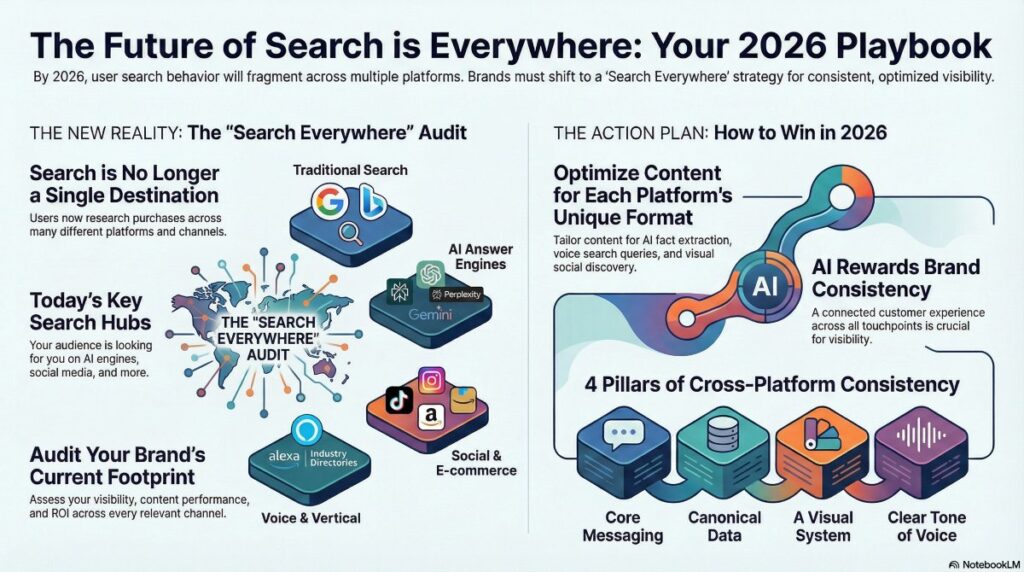
Multimodal AI search combines text, images, video, and voice simultaneously, with Google’s Gemini and other platforms enabling users to interact across multiple formats—requiring content that works across all input and output formats.
The future of search isn’t choosing between text, voice, or visual—it’s all three, simultaneously.
What Multimodal Really Means for Content Strategy
Imagine a user photographs a competitor’s trade show booth and asks an AI: “What solutions does this company offer and how do they compare to alternatives?” The AI processes the visual (reading booth signage, identifying logos), combines it with web research, and delivers a response with visual comparison elements.
This scenario requires your brand to have:
- Visually optimised presence: Images with proper alt text, file naming, and contextual content
- Voice-friendly content: Conversational phrasing that works when read aloud
- Video accessibility: Transcripts, captions, and structured metadata
- Semantic clarity: Content that connects visual, textual, and spoken contexts
Is Your Business Ready to Adapt?
These shifts in search behaviour require partners who understand both where we’ve been and where we’re headed. At Blacksmith SEO, we’ve guided marketing teams through every major algorithm update and platform evolution—not by chasing trends, but by understanding the fundamental principles that make content valuable to audiences and discoverable by the systems they use.
We don’t offer quick fixes or traffic guarantees. We forge sustainable strategies that build genuine authority: the kind that earns citations across answer engines, generates organic conversations, and creates lasting competitive advantages.
Get in touch with us to start planning your content marketing strategy!
Common Questions People Ask About Perplexity AI and Digital Marketing:
What is Perplexity AI, and how does it change digital marketing?
Perplexity AI redefines search by delivering direct, conversational answers supported by credible citations, enabling businesses to meet user expectations more effectively.
How does Perplexity AI differ from traditional search engines like Google?
Unlike Google, which offers a list of links, Perplexity AI provides concise, cited responses, making it ideal for transactional and quick-answer queries.
How can Perplexity AI and Google be used together for better SEO?
Businesses can use Perplexity AI for precise answers and Google for broader, exploratory searches, ensuring a well-rounded digital strategy.
What are entities, and why are they critical for Perplexity AI optimization?
Entities are distinct concepts like products or services. Optimizing for entities helps businesses rank higher by aligning with AI’s focus on precision and relevance.
What steps should businesses take to optimize for Perplexity AI?
Businesses should craft concise, intent-focused content, use schema markup for structured data, and monitor performance across platforms to refine their strategies.
What is Generative Engine Optimization (GEO), and why does it matter?
GEO focuses on optimizing for AI-driven search tools like Perplexity AI, emphasizing the need for precise, user-focused content.