
Quick Summary:
Tourism SEO is how travel brands; hotels, tour operators, vacation rental managers, destination management companies (DMCs), build organic visibility that drives direct bookings without surrendering 15–30% of every reservation to online travel agencies (OTAs) like Booking.com and Expedia. Organic search delivers the highest-intent traffic in travel, and with AI Overviews now reducing top-ranking organic click-through rates (CTR) by 58% (Ahrefs), the brands that structure their content for both traditional and AI-powered search will capture the bookings that OTA-dependent operators lose.
Key takeaways:
- OTA commissions eat 15–30% of every booking — and you lose the customer’s data entirely
- Organic search drives the highest-intent travel traffic — 63% of all U.S. web traffic referrals come from Google (Ahrefs)
- AI Overviews are reshaping travel search — organic CTR for top-ranking pages has dropped 58% on queries where AI Overviews appear
- SEO compounds over time — content published today still drives bookings 12, 24, and 36 months later
- Tourism brands that invest in SEO build an asset, not a recurring expense
Acronyms you’ll see throughout this blog:
OTA → online travel agencies like Booking.com and Expedia
DMCs → destination management companies
CTR → click-through rates
PPC → pay-per-click
GBP → Google Business Profile
VR → vacation rental
Why Tourism Brands Can’t Afford to Ignore SEO
Every tourism operator who relies on OTAs is renting their visibility. OTA commission rates have climbed steadily over the past decade — the industry average now sits between 15% and 30%, depending on platform, market, and property type. Booking sites make up over half of all online hotel reservations, which means most operators are handing a significant cut of their revenue to platforms they don’t control. That’s not a distribution cost. That’s a margin problem.
And the cost goes beyond commissions. When a guest books through Booking.com or Expedia, you don’t get their email address, their browsing behaviour, or the ability to retarget them for a return visit. The OTA owns that relationship. You fulfilled the stay. They kept the customer.
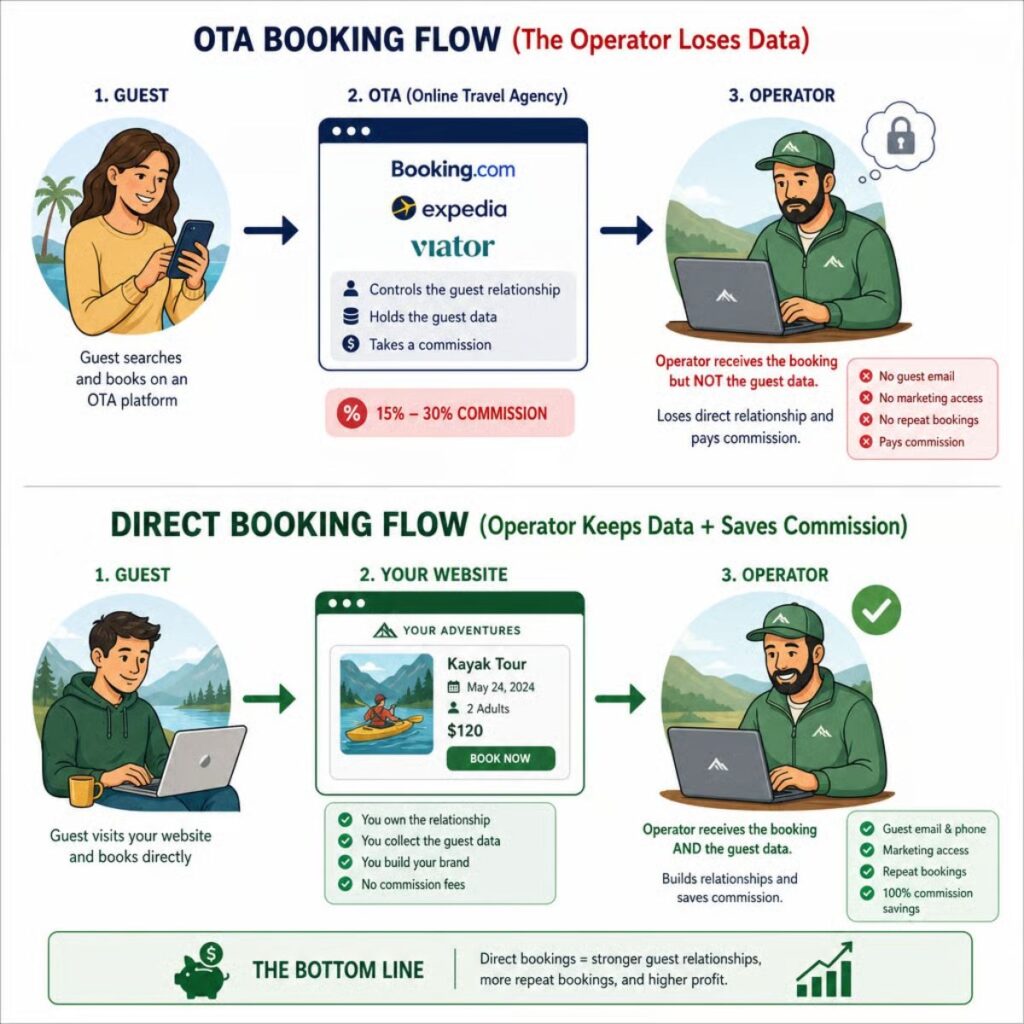
I’ve watched this dynamic play out across our tourism portfolio — vacation rental managers paying Airbnb 15% on every booking while simultaneously struggling to fill shoulder-season gaps that a strong organic presence would solve.
Across four vacation rental properties we manage SEO for — organic search delivered over 128,000 clicks between July 2025 and June 2026, with roughly 96% of that traffic coming from non-branded queries (excluding each property’s brand name, URL variations, and branded phrases)
That’s travellers discovering these properties through destination and activity searches, not by already knowing the brand name. The operators who break free from OTA dependency don’t do it by negotiating lower commission rates. They do it by building direct booking channels that compound over time.
The paid ads treadmill
Paid search is the other trap tourism brands fall into. Google Ads delivers immediate visibility, but it’s a treadmill: stop paying, stop appearing. Across industries, SEO drives 1,000%+ more traffic than organic social media — and unlike paid channels, organic traffic doesn’t disappear when the budget runs out.
The real difference isn’t cost per click. It’s the asset model. Every blog post, destination page, and optimised listing you publish is an asset that continues generating traffic for years. Every paid click is a transaction that ends when the budget does. The top three organic results capture 68.7% of all clicks on a search page — which means ranking well for travel queries delivers a compounding return that no paid campaign can match.
Zero-click search and what it means for travel
Here’s the trend that makes SEO even more urgent: a growing share of Google searches end without a click to any website. Google’s AI Overviews, featured snippets, and knowledge panels answer queries directly in the search results. For tourism brands, this means your content needs to be structured well enough that Google extracts and surfaces it — because if your competitor’s content gets pulled into an AI Overview and yours doesn’t, you’ve lost the visibility without even competing for the click.
How Search Has Changed for Travel and Tourism
Search behaviour in travel has shifted more in the past 18 months than in the previous five years. The biggest driver: AI-powered search features that answer queries before travellers ever click through to a website.
An Ahrefs study of 300,000 keywords found that Google’s AI Overviews reduce click-through rates for top-ranking pages by 58% — meaning for every 100 clicks a travel brand could historically earn, Google now keeps 58 of them. According to Search Engine Journal, zero-click searches have climbed from 56% to 69% of all queries in the past year alone.
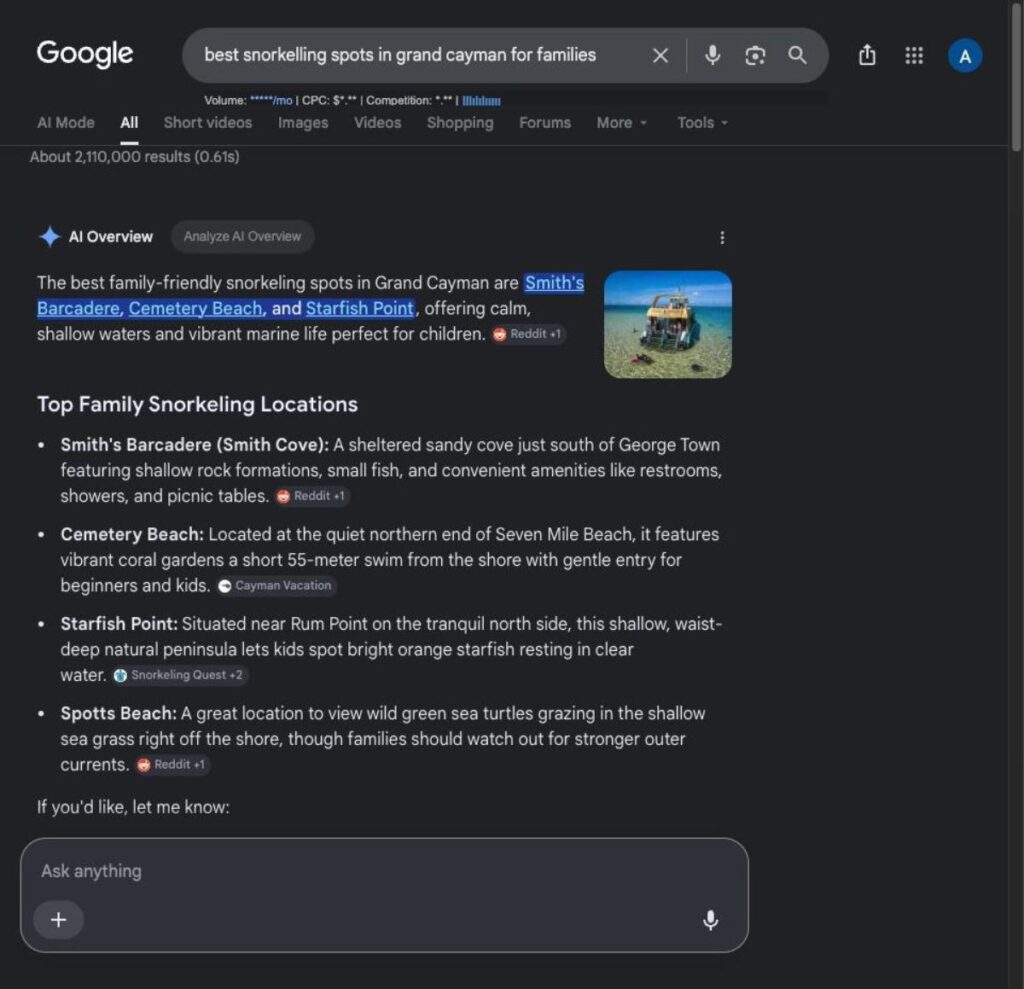
What does this look like in practice? A traveller types “best snorkelling spots in Grand Cayman for families with young kids” into ChatGPT or Google’s AI Mode — and gets a synthesised answer drawn from whatever content the AI system trusts most. If your destination page is well-structured, experience-rich, and entity-specific, your content becomes the source material for that answer. If it’s a thin brochure page with stock photos and generic descriptions, it gets skipped entirely.
What AI search rewards in travel content
In our experience working across tourism verticals — from Hawaiian vacation rentals to Costa Rican surf lodges to Oregon Coast beach houses — the content that performs in AI search shares three traits:
- First-hand experience signals. AI systems weigh content that demonstrates the author has actually been there, managed the property, or run the operation. Generic “10 things to do” listicles get deprioritised.
- Entity-specific language. Naming the beach, the trail, the restaurant, the regulation — not “beautiful beaches” but “Rum Point Beach on the North Side of Grand Cayman.” AI surfaces specific answers, not vague ones.
- Structured, extractable blocks. Direct answers in the first 40 words of a section. FAQ pairs. Comparison tables. Step lists. These are the shapes AI systems can lift and present as answers.
Google’s own AI Optimization Guide confirms this isn’t a separate discipline from regular SEO — it’s the same principles pushed further. Write for humans first, and AI search rewards the same content.
What Travel SEO Actually Involves
Tourism SEO isn’t one thing. It’s four disciplines working together, each solving a different visibility problem.
Search Intent Mapping for Tourism Keywords
Every travel search sits on a spectrum from dreaming to booking. The mistake most tourism websites make is optimising only for booking-intent keywords (“book a villa in Cayman Kai”) while ignoring the research-stage queries that travellers ask months before they buy.
The intent stages look like this:
| Intent Stage | Example Queries | Content Type |
| Dreaming | “best Caribbean islands for families” | Destination guides, comparison posts |
| Planning | “things to do in West Maui,” “Cayman snorkelling spots” | Activity guides, area pages |
| Comparing | “Airbnb vs direct booking,” “boutique hotel vs resort” | Comparison content, pricing guides |
| Booking | “vacation rental Kāʻanapali beach,” “book eco lodge Costa Rica” | Property pages, landing pages |
The pattern we see across our tourism portfolio is that brands ranking for dreaming- and planning-stage queries capture travellers before they even reach an OTA. By the time they’re ready to book, they’ve already been on your site three or four times. The OTA never enters the picture.
Technical SEO for Travel Websites
Travel websites have unique technical challenges that generic SEO advice doesn’t address.
Mobile performance is non-negotiable. Over 70% of travel website traffic comes from mobile devices, and travellers are often searching on spotty hotel Wi-Fi or cellular data. If your property page takes 6 seconds to load because of uncompressed hero images, you’ve lost the booking before the page renders. Core Web Vitals — Largest Contentful Paint, Cumulative Layout Shift, Interaction to Next Paint — matter more for travel sites than for almost any other vertical.
Schema markup tells search engines what your business is. For tourism operators, the right structured data isn’t just Article and FAQ schema. It’s VacationRental, TouristAttraction, Event, LodgingBusiness — the specific types that help Google understand your inventory. When we audit a tourism website for the first time, the three gaps we find most often are: missing location-specific schema, no FAQ markup on pages that have FAQ content, and property pages with zero structured data despite having all the fields (bedrooms, amenities, coordinates) that schema expects.
Crawlability for large inventory sites. A vacation rental manager with 200 properties needs every listing page indexed and current. That means clean URL structures, updated XML sitemaps, no orphaned pages, and internal linking that distributes authority from your strongest pages to your newest listings.
On-Page SEO and Content Strategy
Content strategy for tourism is seasonal, location-specific, and experience-driven — three dimensions that most generic SEO content ignores.
Seasonal content planning is where tourism brands build their compounding advantage. The content you publish about whale watching season in Maui doesn’t just rank this year — it ranks next year and the year after, accumulating backlinks and search authority each season.
We see this clearly in the data: one luxury resort property client in our portfolio pulls 3.2 times more organic traffic during its peak winter season (November through January) than during its quietest months (April through June). That swing likely reflects seasonal search demand compounding with the evergreen authority these pages have built — the same URLs rank year-round, but clicks concentrate when travellers are actively planning trips. We’ve found that publishing seasonal content 3–4 months ahead of peak booking windows gives it enough time to index, earn links, and climb the rankings before demand spikes.
Destination and experience pages are the backbone of any travel content strategy. Each page targets a specific intent — “snorkelling in Grand Cayman” isn’t the same query as “best beaches in Grand Cayman,” and they shouldn’t live on the same page. The Destination-Experience Matrix is a useful framework: map every destination you serve against every experience you offer, and each intersection is a potential content piece with distinct search intent.
Content decay is real in travel. A restaurant recommendation from 2022 may not be open anymore. A regulation about park entry permits may have changed. Seasonal event dates shift. Tourism content needs a refresh cycle — we typically recommend auditing and updating high-performing pages every 6–12 months, and our guide to fixing content decay walks through the full process.
Local SEO for Tourism Businesses
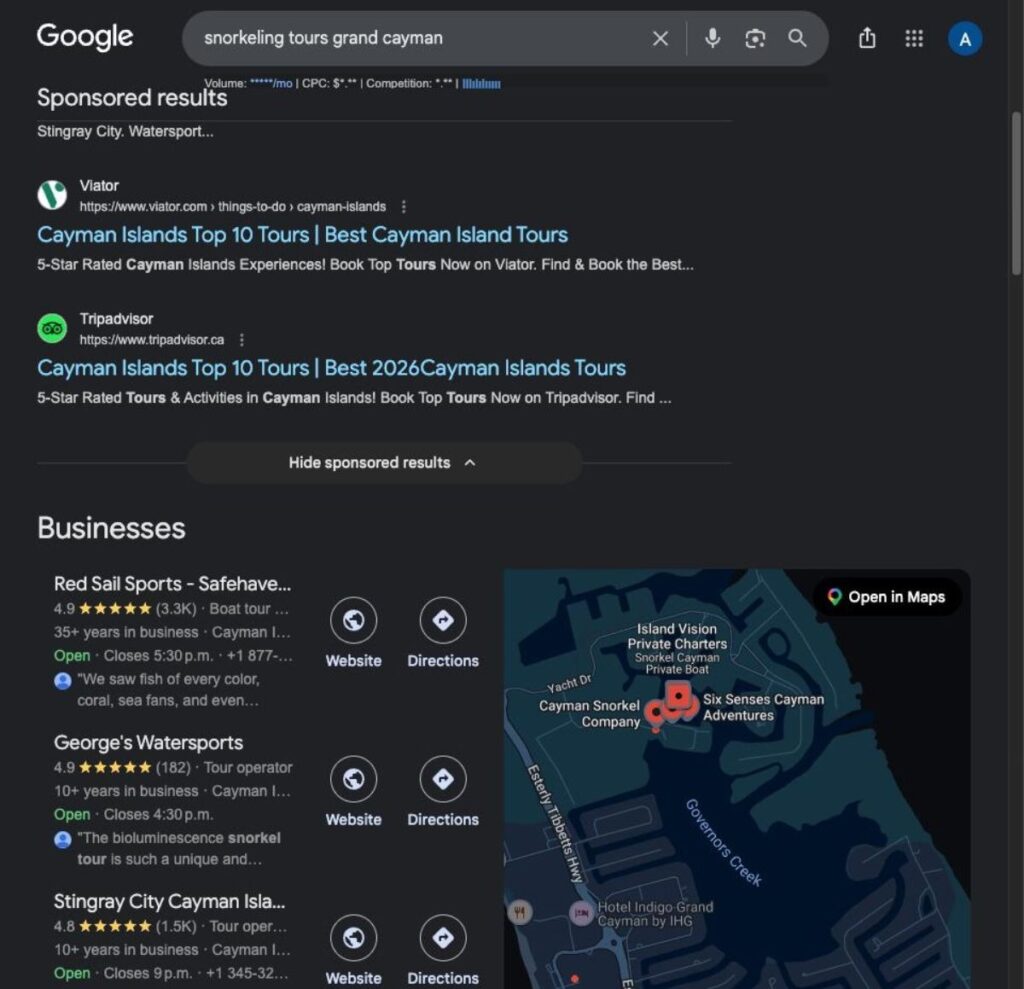
For tour operators, activity providers, boutique hotels, and restaurants, local SEO is often the highest-ROI channel available. Close to half of all Google searches carry local intent, and the Local Map Pack — those three business listings with maps that appear at the top of local queries — captures a disproportionate share of clicks.
Google Business Profile (GBP) optimisation is the foundation. That means complete, accurate listings with:
- Correct business categories (not just “hotel” — use “boutique hotel,” “vacation rental,” “scuba diving tour” as applicable)
- Photos that show the actual experience (not stock images)
- Responses to every review — positive and negative
- Regular posts about seasonal offerings, events, and updates
- Accurate hours, especially seasonal adjustments
The operators we work with who maintain active, photo-rich GBP profiles consistently outrank competitors with more reviews but stale listings. Google rewards activity and completeness, not just star ratings.
How AI Search Changes Tourism SEO
Answer Engine Optimisation (AEO) isn’t a replacement for traditional SEO — it’s an extension of it. But it requires specific structural choices that most tourism websites aren’t making yet.
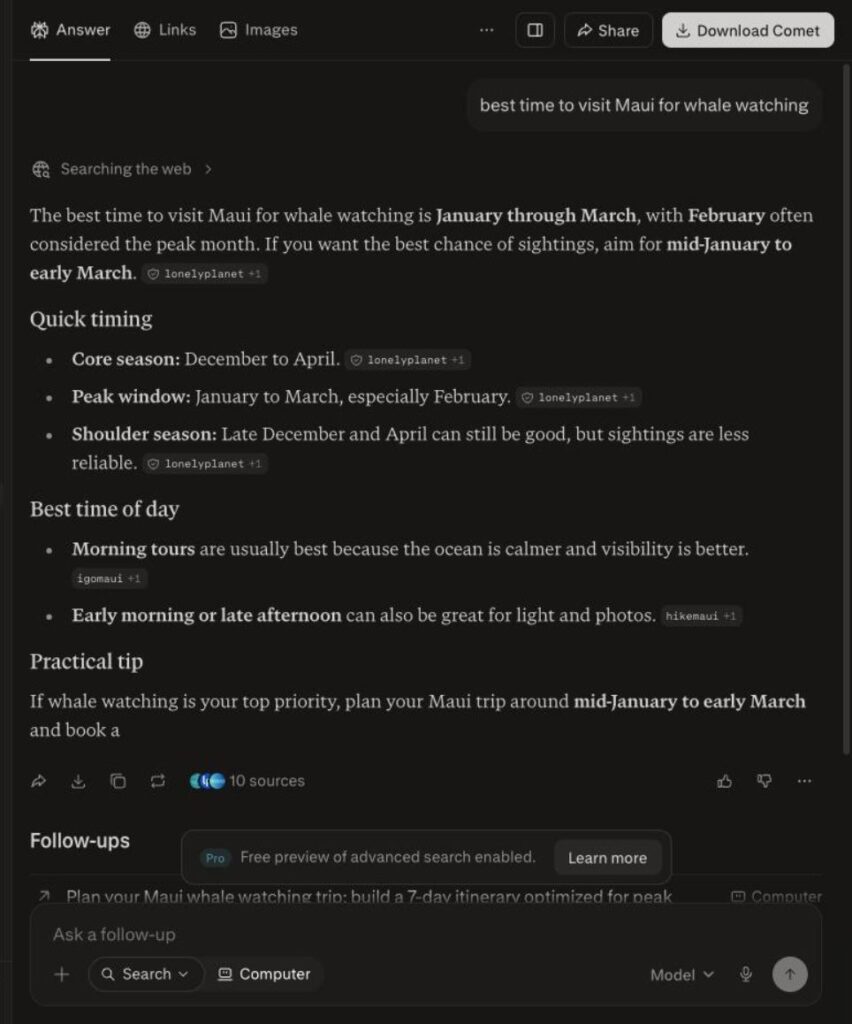
Hosts and operators we talk to are increasingly asking about AI search — how ChatGPT, Google’s AI Mode, Perplexity, and Claude are changing how travellers discover properties and destinations. The short answer: these systems synthesise answers from the content they trust most, and trust is built through the same E-E-A-T signals (Experience, Expertise, Authoritativeness, Trustworthiness) that Google has prioritised for years.
Structuring content for AI extraction
AI systems don’t read your page the way a human does. They scan for extractable blocks — self-contained passages that answer a specific question clearly enough to be lifted and presented as part of a synthesised response.
For tourism content, the highest-value extractable blocks are:
- Direct-answer openers. Start each section with a 35–45 word paragraph that directly answers the question implied by the heading. “The best time to visit Maui for whale watching is December through April, when humpback whales migrate to the warm Hawaiian waters to breed and calve.”
- Comparison tables. SEO vs. pay-per-click (PPC) vs. OTA cost structures. Best months to visit by activity type. Property amenities by price tier.
- FAQ pairs. Concise 40–60 word answers to the specific questions travellers actually ask — sourced from People Also Ask data and forum discussions, not invented.
- Named entities. Every specific beach, trail, restaurant, regulation, and landmark mentioned by name — not “a popular beach” but “Seven Mile Beach in the West Bay area.”
The “About this guide” pattern
Google’s Helpful Content guidelines emphasise transparency about who created the content and how. For tourism SEO, this means every substantial piece should end with a brief disclosure naming the author’s credentials, the sources consulted, and the editorial process. This isn’t just a trust signal for readers — it’s a quality signal that AI systems use when deciding which sources to cite.
Experiential content as a differentiator
Here’s what AI can’t fabricate: first-hand experience. A guide to snorkelling in the Cayman Islands written by someone who has actually managed properties on Cayman Kai, walked the beaches, and talked to guests about water conditions carries signals — specific details, situational advice, insider knowledge — that AI-generated content doesn’t have. Google calls this the “Experience” in E-E-A-T, and it’s the single hardest signal to fake.
For tourism brands, this is your moat. Your property managers, tour guides, concierge teams, and local operators have knowledge that no AI system can replicate. The brands that win in AI search will be the ones that get that knowledge onto their website in structured, extractable form.
What to Look for in Travel SEO Services
Not every SEO agency understands tourism. The vertical has unique challenges — seasonality, location-specific content, OTA competition, multi-property inventory management, review ecosystem dynamics — that generic SEO playbooks don’t address.
Red flags
- Guaranteed rankings. No one can guarantee a #1 position. Anyone who promises it is either lying or planning to use tactics that will get your site penalised.
- Black-hat link building. Paid link schemes, private blog networks (PBNs), and link farms still exist in tourism SEO. They work until they don’t — and when Google catches them, the recovery takes months.
- No reporting on business outcomes. Rankings are a vanity metric if they don’t translate to bookings.
- No vertical experience. Tourism SEO requires understanding how travellers search, how OTAs compete, how seasonality affects demand, and how local SEO drives in-destination discovery.
Green flags
- Portfolio of tourism or hospitality clients — they’ve solved these problems before
- Combined content and technical capability — tourism SEO requires both
- Transparent process with clear deliverables — you should know what’s being produced, when, and why
- Reporting tied to business metrics — direct bookings, organic revenue, cost per acquisition
- Understanding of AI search — if they’re not talking about AI Overviews and AEO, they’re behind
In-house vs. agency vs. fractional SEO
There’s no single right model. It depends on your scale, budget, and internal capability.
| Model | Best For | Typical Investment | Consideration |
| In-house SEO hire | Large hotel groups, resort chains with 50+ properties | $60K–$120K/year salary + tools | Requires management, training, tool subscriptions |
| Full-service agency | Mid-size operators wanting comprehensive SEO + content | $3K–$10K/month | Look for tourism vertical experience specifically |
| Fractional SEO | Boutique hotels, small tour operators, growing vacation rental (VR) managers | $1K–$3K/month | Strategy and oversight with your team executing |
At Blacksmith, we offer both full-service SEO and fractional SEO models — because a 5-property vacation rental manager and a 200-property resort chain need fundamentally different levels of support.
Tourism SEO Results — What’s Realistic?
SEO is not a quick win. Any agency that promises first-page rankings in 30 days is selling a fantasy. Here’s what a realistic timeline looks like for tourism brands.
Months 1–3: Foundation. Technical audit, site speed optimisation, schema implementation, keyword research, content strategy development. You likely won’t see ranking improvements yet — and that’s normal. This is the investment phase.
Months 3–6: Traction. New content starts indexing and ranking for long-tail queries. Technical fixes improve crawlability and page speed. You’ll see impressions and clicks growing in Google Search Console, and early rankings for lower-competition keywords.
The exception is properties that launch with existing destination content — one Caribbean vacation rental in our portfolio inherited a library of location pages that had never been technically optimised. Once we resolved crawlability issues and implemented schema, those pages gained traction almost immediately, reaching over 1,600 non-branded clicks in their first month under management. That’s not the typical trajectory; it’s what happens when solid content was already in place but wasn’t being surfaced properly.
Months 6–12: Compounding. Older content accumulates backlinks and authority. Seasonal content starts ranking for its target windows.
That same client we mentioned doubled again in the following months, crossing 3,300 clicks per month — an ~ 105% increase from month five to month ten.
You’ll see meaningful organic traffic growth and if your booking flow is optimised — a measurable increase in direct bookings.
Months 12+: The moat. This is where SEO’s compounding nature separates it from every other marketing channel. Content published 12 months ago is still driving bookings. New content builds on the domain authority you’ve already earned. Each piece makes the next piece stronger.
A Hawaii vacation rental property we manage has sustained 5,500–8,300 organic clicks per month for over a year — peaking during high season without any increase in ad spend.
That’s what a mature SEO program looks like: consistent, compounding returns that don’t require you to keep feeding the meter.
The metrics that matter
Rankings are a leading indicator, not the goal. For tourism brands, the metrics that actually matter are:
- Direct bookings from organic traffic — this is the bottom line
- Organic revenue vs. OTA commission costs — are you shifting the balance?
- Cost per acquisition from organic vs. paid vs. OTA — how efficient is each channel?
- Organic traffic by intent stage — are you capturing travellers at the dreaming and planning stages, or only at booking intent?
- AI surface citations — is your content being referenced in Google AI Overviews, ChatGPT, and Perplexity? Our answer engine tracking and reporting tools help measure this specifically.
Is Your Travel Website SEO-Ready? A Quick Self-Assessment
Before investing in tourism SEO — whether in-house or with an agency — run through this checklist:
If you checked fewer than 3, there’s a significant opportunity. If you checked all 7, you’re ahead of most tourism operators — and a strategic SEO investment can compound what you’ve already built.
About This Guide
This guide was written by Abhinav Malhotra.
Abhinav handles content and AI enabled strategy at Blacksmith SEO & Digital, drawing on direct experience managing SEO campaigns for tourism and vacation rental clients across multiple markets across the globe. Primary sources include Google’s official AI Optimization Guide, Google’s Helpful Content documentation, Ahrefs’ research on AI Overviews and organic search performance, Search Engine Journal’s analysis of AI search impact on publishers, and HubSpot’s hotel industry data. All statistics cited are from sources published within the past 18 months and verified at the time of writing.
Frequently Asked Questions
How do travel companies rank against OTAs in search results?
OTAs dominate broad, high-volume keywords (“hotels in Maui,” “vacation rentals Cayman Islands”) through massive domain authority and paid ads. Tourism operators compete by targeting specific, intent-rich queries that OTAs can’t personalise — “family-friendly snorkelling Cayman Kai,” “pet-friendly beach house Cannon Beach Oregon.” Long-tail, location-specific, experience-driven content is where independent operators win.
Is SEO worth it for small hotels and tourism businesses?
Yes — and arguably more so than for large chains. Small tourism businesses can’t outspend OTAs on advertising, but they can outrank them on specific, experience-rich queries. Local SEO is particularly high-ROI for small operators because Google Business Profile visibility is earned through relevance and activity, not budget.
How long does SEO take to work for a tourism website?
Expect 3–6 months for measurable traction on long-tail keywords and 6–12 months for competitive terms. Tourism SEO has a seasonal dimension that other verticals don’t — content published for whale watching season or ski season may take a full annual cycle to reach peak performance, then compounds in subsequent years.
What keywords should tourism websites target?
Start with destination + activity combinations (“snorkelling Grand Cayman,” “hiking trails near Aspen”), then expand into planning-stage queries (“best time to visit [destination],” “what to pack for [destination]”), comparison queries (“Airbnb vs direct booking [destination]”), and local-intent queries (“tours near me,” “best restaurants [area]”). Use tools like Ahrefs or Google Search Console to validate volume and difficulty.
Should tourism businesses invest in SEO or PPC?
Both, but with different roles. PPC delivers immediate visibility for booking-intent queries during peak season. SEO builds the long-term organic foundation that drives traffic year-round without per-click costs. Organic search drives over 1,000% more traffic than organic social media, and unlike paid leads, organic leads compound over time — each piece of content continues earning clicks long after you publish it.
How does AI search affect tourism marketing?
AI Overviews now reduce organic click-through rates by up to 58% on queries they appear for, according to Ahrefs research. AI systems like Google’s AI Mode, ChatGPT, and Perplexity pull answers from content they trust — content with first-hand experience signals, specific entities, structured FAQ blocks, and clear source attribution. Tourism brands that structure their content for AI extraction get cited as sources; those that don’t get bypassed entirely.
What does a tourism SEO service typically include?
A comprehensive tourism SEO engagement includes: technical site audit and optimisation, keyword research specific to your destinations and services, content strategy and production (destination guides, activity content, seasonal posts), local SEO and Google Business Profile management, link building through travel industry relationships, and ongoing performance reporting tied to bookings and revenue — not just rankings.
