
Last Updated: 20 August 2026
Quick Summary
Reviews are no longer just trust signals for customers. They are third-party evidence AI systems use to decide which businesses to recommend. But the two surfaces work differently. Whitespark’s 2026 survey of 47 local SEO experts ranks third-party review diversity near the bottom of 187 local search ranking factors, while third-party citation signals fill three of the top five AI search visibility factors. Your position in Google’s local results still runs on Google Business Profile. Licensed third-party data increasingly feeds AI answers — Yelp now powers local recommendations in ChatGPT, Apple Maps and Bing. Where you collect reviews decides which surface can see you.
Does Review Diversification Improve Your Google Business Profile Ranking?
Not meaningfully. Whitespark’s 2026 Local Search Ranking Factors report asks 47 local search practitioners to rank 187 things that influence visibility in the local pack — the map and three business listings Google shows above the regular results. Reviews left directly on your Google Business Profile land in the top 15. Reviews spread across third-party sites land outside the top 100.
That gap is the finding.
| Review signal | Ranking (out of 187) |
| Quantity of Google Business Profile reviews with text | 9th |
| Recency of reviews | 11th |
| Steady flow of reviews over time, rather than bursts | 14th |
| Diversity of third-party sites where reviews appear | 105th |
| Quantity of reviews on industry-specific sites | 106th |
Source: Whitespark, 2026 Local Search Ranking Factors
So if your goal is the local pack when someone searches “plumber near me,” concentrating on your Google Business Profile is still correct.
Greg Gifford, Chief Operating Officer at SearchLab and a 20-year local SEO practitioner, made the same point from the stage at SEO Estonia 2026, where his session was titled “Customer Reviews: The Key to Being a Search Results Superhero.” His session made the case that Google reviews have become increasingly important in the algorithm in recent years, and that customer reviews now influence both Google rankings and AI recommendations.
That second half is where this gets interesting, because the two do not work the same way.
Why Does Review Diversity Matter for AI Search if It Barely Moves the Local Pack?
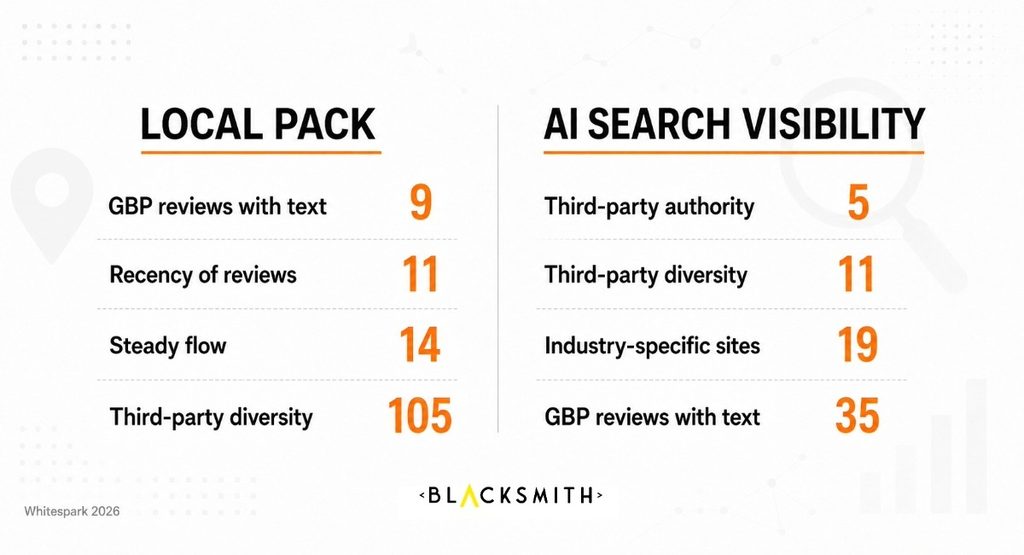
Because AI answers are assembled from different inputs than search rankings. Whitespark scored AI search visibility separately for the first time in 2026, and the same factors change places. Diversity of third-party review sites climbs from 105th to 11th. Authority of those sites ranks 5th. Google Business Profile reviews with text, 9th for the local pack, fall to 35th. Three of the top five AI visibility factors are citation factors — best-of lists, industry-relevant domains, and the authority of sites citing you.
Darren Shaw, who runs the survey, is blunt about what changed: “In AI SEO, mentions (citations) are the new link.” His recommendation to businesses follows from it — get reviews on the prominent review sites in your industry, because you can’t just send review requests to Google anymore.
Aaron Smith, Principal Strategist at Blacksmith, frames the same shift from the client side: “Google Business Profile should remain a core component, but it should be part of a broader, industry-specific reputation ecosystem, and not the entire strategy.”
Independent Corroboration
An answer engine generating a recommendation needs evidence it did not get from the business itself. A claim appearing independently across unrelated sources carries more weight than the same claim made once, by you, on your own site. As Aaron puts it: “A diversified review strategy creates corroboration. When the same positive qualities appear independently across multiple trusted sources, search engines, AI systems, and prospective customers have stronger reasons to believe them.”
This is the same dynamic we covered in our piece on brand authority after Google’s FAQ removal update — off-site corroboration does work that on-site optimisation cannot.
Retrieval Routing
Some review data now reaches AI systems through commercial agreements rather than crawling. That distinction matters more than it sounds. A crawler decides what to index; a licensing deal decides what an engine reads by default, and being absent from a licensed dataset isn’t something you can fix with better content on your own site. If an answer draws on a licensed feed your business isn’t in, that feed can’t supply any evidence about you. Other routes may still exist, but that one is closed regardless of how good your own site is.
Query Fan-Out
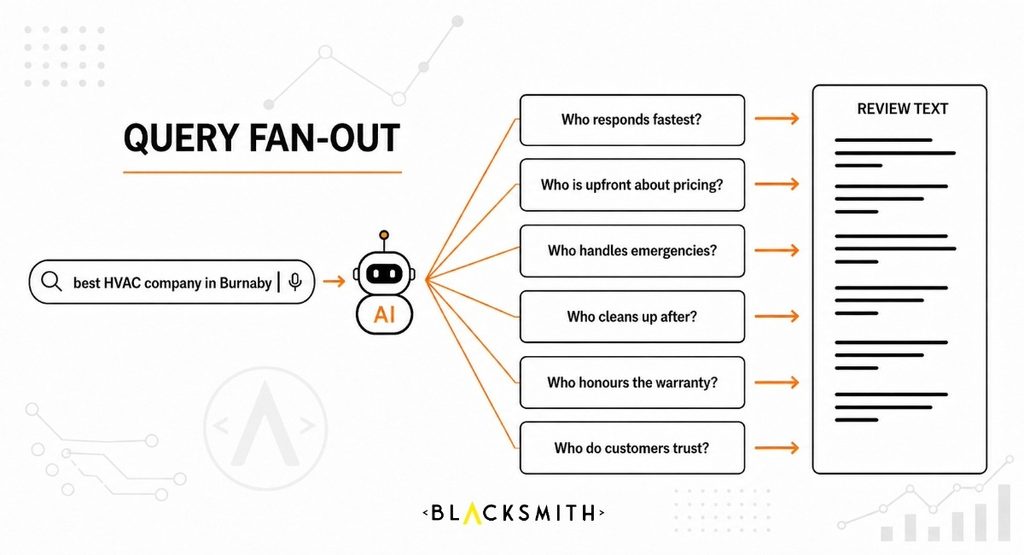
Google’s AI Mode does not look a question up once. It decomposes it first. Writing at Google I/O 2025, Elizabeth Reid, Google’s VP and Head of Search, described the mechanism: AI Mode uses a query fan-out technique, breaking a question down into subtopics and issuing a multitude of queries simultaneously on the user’s behalf.
So “best HVAC company in Burnaby” becomes a cluster of sub-questions: who responds fastest, who is transparent about pricing, who handles emergency calls, who cleans up afterwards. Those are attribute-level questions, and attribute-level answers live in review text rather than in star ratings. It’s the retrieval behaviour we described in our breakdown of Google’s passage ranking, applied to third-party content instead of your own.
A five-star rating with no text answers none of those sub-questions. A three-sentence review mentioning same-day scheduling, a fixed quote and a tidy worksite answers three.
How Do AI Engines Get Review Data — Do They Crawl It or License It?
Increasingly, they license it. Several of the largest review datasets now reach AI answer engines through negotiated commercial agreements, which makes presence on those platforms a precondition for appearing in those answers.
Yelp and OpenAI
Axios reported in July 2026 that Yelp had licensed its reviews, ratings, photos and business information to OpenAI, giving ChatGPT a source of real-time local recommendation data. Yelp’s branding and links appear when OpenAI uses its content, though OpenAI controls the design of that experience. The companies did not disclose financial terms, and the arrangement does not prevent Yelp from making similar deals with other AI companies.
Yelp CEO Jeremy Stoppelman put the company’s position bluntly: “If you want to answer local queries, you really need Yelp.”
That was the starting point rather than the finish. In August 2026 Yelp announced on its own blog that Reservations and Waitlist now run inside ChatGPT for restaurants across the United States and Canada, describing the content integration as already in place. Yelp says its local content and selected task-completion features are available across: ChatGPT, Apple Maps, Amazon’s Alexa+, Microsoft Bing, DuckDuckGo, Yahoo and several automotive brands — including the ability to request quotes from service providers.
For a Canadian business that last detail matters more than the headline. The restaurant booking integration explicitly covers Canada, and the quote-request path is live for service providers.
Tripadvisor and Perplexity
This one has been running longer. Tripadvisor announced in January 2025 that it was integrating its reviews, AI-generated summaries and Viator’s experiences inventory into Perplexity’s answer engine. Travel is one of Perplexity’s largest query categories, and the partnership has since extended into hotel booking. If you operate in tourism or hospitality this is not speculative — it is a documented pipeline that has been live for over a year. Our guide to optimising for Perplexity and answer engines covers the wider surface.
G2 and Capterra
G2 announced in January 2026 that it had agreed to acquire Capterra, Software Advice and GetApp from Gartner, with the transaction expected to close in the first quarter. The combined business holds around six million verified reviews and reaches more than 200 million annual software buyers. In G2’s own announcement, CEO Godard Abel described it as building “the trusted data foundation for buyers and sellers of software” — and the release explicitly names answer engine optimisation as part of the rationale.
The implication is the same in all three cases. When retrieval runs on a licensed dataset, your visibility in that answer is a function of whether you exist in the dataset. That is a different problem from ranking, and it has a different solution.
What Happens When You Ask Customers for a Yelp Review?
Yelp’s recommendation software may identify reviews that appear to have been requested and decline to recommend them, which means they don’t contribute to your star rating.
Yelp’s Trust & Safety documentation lists solicited reviews among the categories its software screens for, alongside conflicts of interest. Its guidance to businesses is unambiguous: proactively asking for reviews may hurt your Yelp rating, because the software may decline to recommend reviews that appear prompted or encouraged by the business.
So Yelp presents businesses with an awkward combination. It’s feeding local recommendations into ChatGPT, Apple Maps and Bing, which makes a Yelp presence more valuable than it has been in years. And it’s the one major platform where the standard review-request playbook will cost you the reviews you generate. The answer isn’t to skip Yelp. It’s to work it differently from Google.
What doesn’t work on Yelp
Review request emails, SMS campaigns, QR codes at the till, “leave us a review” cards, in-person asks, and routing your Google review workflow to also hit Yelp. Feedback surveys followed by a Yelp request fall under the same policy. Incentives are prohibited outright and may also be illegal.
What works instead
Claiming and fully completing the profile. Keeping hours and service categories accurate. Uploading current photos. Enabling Request a Quote if you’re a service business, or Guest Manager if you’re a restaurant. Responding to the reviews you receive. On Yelp you build the surface that earns reviews rather than requesting them.
| Google Business Profile | Yelp | |
| Asking for reviews | Permitted | Prohibited; solicited reviews may not be recommended |
| Incentives | Prohibited | Prohibited |
| Review gating | Prohibited | Prohibited |
| Where effort goes | Request workflow | Profile completeness and response |
| Primary payoff | Local pack position | AI answer retrieval across several engines |
Any agency or tool promising to “get you more Yelp reviews” through an automated request sequence is selling something Yelp is explicitly designed to catch.
Which Review Platforms Should Your Industry Prioritise?
Three to five channels, chosen for how your customers find and buy. Aaron’s rule of thumb: “The objective should therefore be quality and distribution, not volume alone.”
| Industry | Foundation | Add for AI visibility | Add conditionally |
| Trades & home services | Google Business Profile | Yelp — profile completeness and Request a Quote, not review requests | Angi for marketplace demand; HomeStars in Canadian markets; Houzz for remodel and design-build; BBB only if it already sends you leads |
| Restaurants | Google Business Profile | Yelp, including Guest Manager, now bookable inside ChatGPT | Tripadvisor where tourism demand is real; OpenTable or Resy for verified reservation diners |
| Tourism & hospitality | Tripadvisor — the documented Perplexity pipeline | Google Business Profile at brand level where eligibility allows | Viator for experience operators |
| Short-term & vacation rentals | The booking platform that drives your revenue — Airbnb, Vrbo or Booking.com | Tripadvisor | A separate brand-level Google Business Profile where eligibility allows |
| Property management | Google Business Profile | Trustpilot for owners and higher-consideration prospects | BBB where it generates enquiries |
| Real estate | Google Business Profile | Zillow | One market-relevant agent portal — RateMyAgent or Realtor.com — rather than spreading across many |
| E-commerce | On-site product reviews with correct product review markup | Trustpilot | Google Customer Reviews for the store-level seller badge; native marketplace ratings if you sell on Amazon or Etsy |
| Marketplaces | Native transaction ratings | Trustpilot | App Store and Google Play for mobile-first models; G2 for B2B models |
| B2B software & services | G2 | Gartner Peer Insights or TrustRadius | Clutch for agencies and professional services |
Healthcare and legal are absent deliberately — review strategy in regulated professions carries compliance considerations this piece doesn’t address. Facebook is worth growing but shouldn’t displace anything above.
Angi, Not Angie’s List
Angie’s List was rebranded as Angi in 2021, and HomeAdvisor’s lead-generation business is now part of Angi, whose consumer site is Angi.com. If your review strategy document still lists them as separate channels, the advice built on it is out of date.
BBB and Lead Flow
Whitespark’s contributors rank BBB accreditation 133rd of 187 for local pack impact. That isn’t an argument against BBB — it’s an argument for being honest about why it’s there. If BBB sends you enquiries, keep it. If it doesn’t, that budget belongs elsewhere.
Double-Sided Markets
A business operating a double-sided market — an RV rental platform, a short-term rental manager, an equipment marketplace — has two distinct audiences leaving reviews: buyers, and supply-side participants like RV owners or condo owners. They search differently, they use different platforms, and they describe entirely different experiences. If you’re trying to grow both sales and supply, work out which reviewer role each platform actually captures before you send anyone anywhere.
Is Reddit a Review Channel or Something Else?
Something else — and it matters more than the table suggests. Reddit is a significant source for AI citations, but reviews there cannot be requested — soliciting them violates platform norms and reads as astroturfing to the community.
Chris Meabe of Foundation Marketing, speaking at SEO Estonia 2026 on controlling brand narrative in LLMs, described Reddit as now a primary source for LLM citations, with a repeatable process for navigating strict subreddits and improving how both human Redditors and AI models surface a product.
The distinction is the same one that governs Yelp, drawn in a sharper place. On Google you can request. On Yelp you build the surface and wait. On Reddit you participate — answering questions in threads where your category comes up, being useful before being promotional, and accepting that visibility is earned over months rather than campaigned for in weeks. We covered that approach in our piece on Web 2.0 and Reddit.
Keep Reddit entirely out of your review request workflow and treat it as its own discipline.
What Makes a Single Review Usable as Evidence?
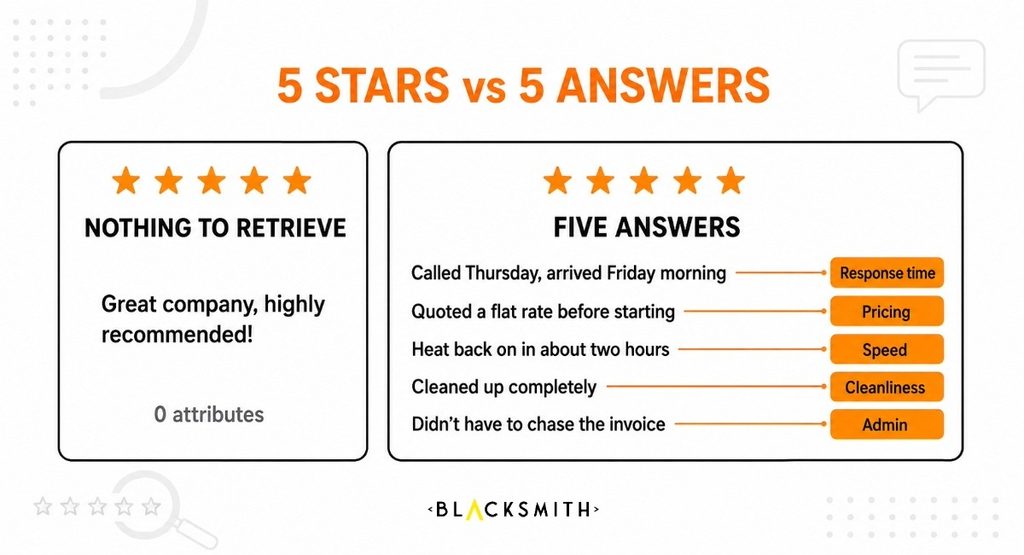
Specificity. A review naming the service, the location, the problem and the outcome answers sub-questions an answer engine is actually asking. A five-star rating reading “Great service” answers none of them.
Most review programmes optimise for a number, because volume and rating are what appear on a dashboard. But the raw material an answer engine works with is language. Aaron’s version: “We know that a simple 5-star review is not enough. We need context for the 5-star — an actual sentence or two that explains the qualities of the service provided and the interaction received.”
At Blacksmith, we call this sentiment harvesting — collecting evidence rather than ratings, across the channels your industry’s answers are assembled from. It’s our term for the practice rather than an industry standard, but it names something the standard vocabulary misses. Review management describes monitoring what already exists. Sentiment harvesting describes deliberately building a body of specific, current, third-party testimony about what your business does well.
Compare these, both five stars:
“Great company, highly recommended!”
“Booked them Thursday for a furnace that had stopped overnight. They came Friday morning, quoted a flat rate before starting, and had heat back on in about two hours. Cleaned up completely. First time I haven’t had to chase someone for an invoice.”
The second contains response time, pricing transparency, resolution speed, site cleanliness and administrative competence — five attribute-level answers from one customer. The first contains nothing retrievable.
One myth worth killing: none of this means keyword-stuffing your reviews. Whitespark’s contributors rank “keywords in owner responses to reviews” 182nd of 187, near the bottom alongside factors they classify as myths. The review is already associated with your brand, your business category and the reviewer’s location. What’s missing is detail, not keywords.
Recency compounds all of it. Whitespark’s contributors rank review recency 11th of 187 for local pack impact, and sustained flow ranks higher than bursts. The logic that governs content freshness applies here — a body of reviews from three years ago describes a business that may no longer exist in that form.
There’s a second return on all of this that has nothing to do with search. Reviews written with that level of detail tell you what customers actually value and where service is slipping. Those themes become your service page subheadings, your FAQ questions, and often your next content brief.
How Strong Is the Evidence That Reviews Affect AI Answers?
Mixed, and worth being specific about where it’s weak. Businesses with reviews across five platforms tend to be businesses with the operational maturity to run a review programme in the first place — so some of what looks like cause is correlation. Three further limits are worth naming before you act on any of this.
Expert Survey, Not Measurement
Forty-seven practitioners scoring 187 factors is the best available proxy, and Shaw says so himself — no contributor has access to Google’s internal systems. It reflects informed observation, not algorithmic ground truth.
Citation Is Not Recommendation
SE Ranking’s January 2026 analysis of 30,000 commercial keywords found that 34.5% of AI Overviews cite at least one review platform. That tells you review platforms are a common source. It does not tell you your presence on one gets your business named in the answer.
The same SE Ranking study found that explicit review searches — queries containing “review” or “rating” — trigger a review platform citation in 49% of AI Overviews, while list-style “best” and “top” queries trigger one only 17.1% of the time. Roughly three times less. So the pitch you may have heard — get reviews everywhere and you’ll get cited for “best sushi in Vancouver” — is not what the data shows.
One Check Tells You Nothing
SparkToro’s Rand Fishkin and Gumshoe.ai’s Patrick O’Donnell ran twelve brand-recommendation prompts through ChatGPT, Claude and Google’s AI over November and December 2025 — 2,961 runs, from headphones to cancer care hospitals. Published in January 2026, the results showed almost no two responses matched. Asked a hundred times, the odds of the same AI returning the same brand list twice were under 1 in 100. Fishkin’s conclusion: measured across many runs, visibility tells you something real. A single check tells you nothing, and it isn’t a ranking.
What Survives
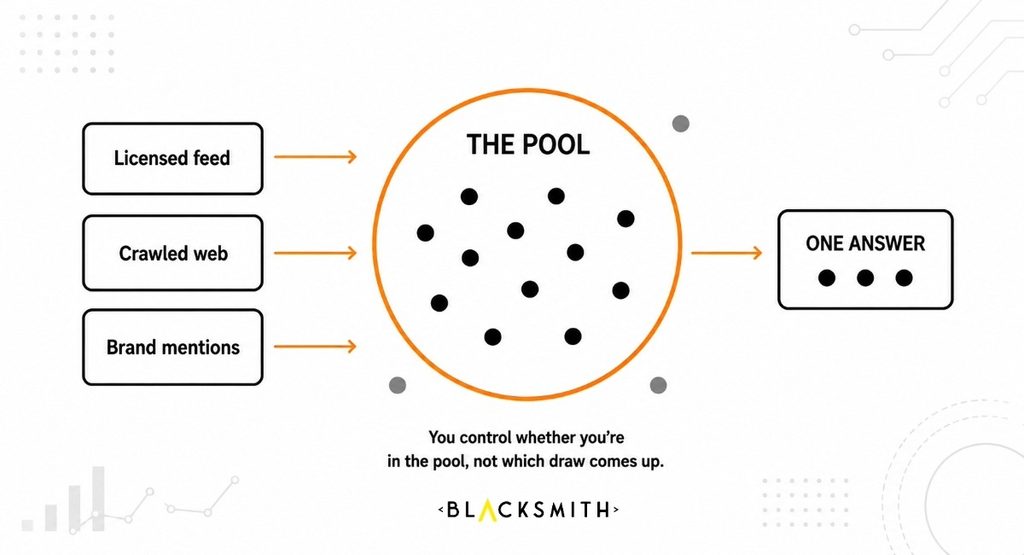
The licensing point, because licensing isn’t correlational. It’s contractual. If ChatGPT is reading a Yelp feed for local recommendations and your business has no Yelp presence, that feed can’t supply any evidence about you — one route into the answer closed, regardless of how good the rest of your marketing is.
Set that against what Fishkin found and the picture resolves. Every answer is a fresh draw from a pool of candidates. You can’t control which draw comes up. You can control whether you’re in the pool. Being in the feed doesn’t guarantee you appear in any given answer. Not being in it guarantees you don’t.
Across the whole argument: the ranking claim is weak, the correlation claim is partial, the retrieval claim holds. Build on the third.
Can You Ask for Reviews Without Breaking the Rules?
On Google Business Profile, yes, provided you don’t gate or incentivise. On Yelp, no. A single review request workflow pointed at both platforms will quietly damage one of them.
Google prohibits offering discounts or rewards in exchange for reviews, and prohibits selectively soliciting only customers you expect to be happy. Within those limits, asking is permitted and useful.
Greg Gifford’s suggestion, presented at SEO Estonia 2026, is the one worth adopting on the platforms where asking is allowed: ask a question instead of asking for a review. “Please leave us a five-star review” produces “Great service.” A specific question produces specific language. The examples below are our adaptation for the verticals we work in.
- Trades: “How did the job go, start to finish?”
- Restaurants: “What did you order, and would you come back for it?”
- Vacation rentals: “What surprised you about the stay?”
- SaaS: “What were you doing before you started using this?”
None of these ask for a rating. None tell the customer what to say. All prompt the detail that becomes retrievable evidence.
One caution, and it’s specific. Google’s review policy prohibits merchants from requesting that specific content be included in a review, and from pressuring customers to leave one while they’re on the premises. The permitted version is narrow: you may encourage a genuine review, but not attempt to influence the rating or the contents of it. So prompt for detail without naming what the detail should be. “How did the job go, start to finish?” is a question. “Mention that we fixed your furnace” is direction, and it’s against policy.
Two related prohibitions catch people out. Conflict-of-interest reviews include those from current or former employees, so staff and family are off the table. And unusual volumes or patterns of review contributions are treated as rating manipulation in their own right — another reason a steady flow beats a campaign.
None of this applies to Yelp, where the answer to “how should I ask?” is that you shouldn’t.
Respond to reviews everywhere. It signals an actively managed profile, it demonstrates accountability to the next person reading, and it’s one of the few parts of this you fully control.
Where Should You Start if You Can Only Change One Thing?
Add the single platform your industry’s answer engines already read, and treat it according to that platform’s own rules. One channel done correctly beats five done generically.
A realistic first quarter:
- Audit what exists. List every platform where your business has reviews, the count, and the date of the most recent one. Most teams find at least one abandoned profile with a two-star average from 2019.
- Pick one addition. Use the table above. For most trades and restaurants that’s Yelp; in Canadian home services, consider HomeStars alongside it. For tourism and hospitality, Tripadvisor. For B2B software, G2.
- Match the method to the platform. Google Business Profile gets a request workflow. Yelp gets a completed profile, enabled quote or booking features, and consistent responses.
- Change the ask where asking is allowed. Replace “leave us a review” with a question, in whatever channel you already use.
- Read the text, not the score. Once a quarter, review what customers actually wrote.
The compounding is slow and unglamorous. It’s also, unlike most of what gets sold as AI visibility work, within your control.
Do You Know Which Platforms Your Industry’s Answers Are Built From?
Most businesses have never audited their review footprint against the surfaces that now assemble recommendations. The gap is usually not effort — it’s routing. Requests go to one platform out of habit, while the engines their customers use read three others under three different sets of rules.
At Blacksmith, we map that footprint as part of how we build search strategy: where your reviews live, where your competitors’ live, and which of those sources the answer engines in your category actually draw on. If you want to see where yours stands, book a free SEO audit.
Frequently Asked Questions
Do reviews on Yelp or Tripadvisor improve my Google Maps ranking?
Not meaningfully. Whitespark’s 2026 Local Search Ranking Factors report ranks third-party review diversity 105th of 187 factors for local pack visibility, while Google Business Profile reviews with text rank 9th and review recency ranks 11th. If your goal is the local pack, concentrating on Google Business Profile is still the correct approach. The case for diversification is about AI search visibility, not rankings.
Does ChatGPT use Yelp reviews?
Yes. Yelp licensed its reviews, ratings, photos and business information to OpenAI in July 2026, giving ChatGPT a source of real-time local recommendation data. In August 2026 Yelp added Reservations and Waitlist inside ChatGPT for restaurants in the United States and Canada. Yelp also reports powering local content and task completion across Apple Maps, Amazon’s Alexa+, Microsoft Bing, DuckDuckGo and Yahoo.
Can I ask customers to leave me a Yelp review?
No. Yelp’s software may identify reviews that appear to have been solicited and decline to recommend them, which means they do not contribute to the star rating. Yelp’s guidance states that proactively asking may hurt your rating. On Yelp, focus on completing your profile, enabling Request a Quote or Guest Manager, and responding to reviews rather than requesting them.
Which review sites matter most for my industry?
It depends on how your customers find and buy. Trades and restaurants should build on Google Business Profile and add Yelp, with HomeStars worth considering for home services in Canadian markets. Tourism and hospitality operators should prioritise Tripadvisor, which has powered Perplexity travel answers since January 2025. Short-term rentals should start with the booking platform that drives revenue. E-commerce should focus on on-site product reviews and Trustpilot. B2B software should focus on G2.
Should I ask customers to leave reviews on Reddit?
No. Reddit is influential in AI citation, but it is not a review collection channel. Soliciting reviews there violates platform norms and reads as astroturfing, and the reputational cost when it is identified outweighs the benefit. Reddit visibility is earned through genuine participation in relevant discussions, not through review requests.
What makes a review useful for AI search?
Specificity and recency. AI answer engines break a question into sub-questions about attributes like response time, pricing transparency and service quality, then look for content that answers them. A review naming the service, the problem and the outcome answers several of those; a five-star rating reading “Great service” answers none. A steady flow of recent, detailed reviews is more useful than a large volume of old, generic ones.
Should I ask customers to include keywords in their reviews?
No. Whitespark’s contributors rank keywords in owner responses to reviews 182nd of 187, near the bottom of the factor list. The review is already associated with your brand, your business category and the reviewer’s location. What adds value is detail about the actual service and outcome, not planted terms.
Can I offer a discount in exchange for a review?
No. Google and Yelp both prohibit incentivised reviews, and Google also prohibits review gating — selectively soliciting only customers you expect to be positive. Both carry real risk to your profile, and incentivised reviews may also be illegal in some jurisdictions. Where asking is permitted, ask a specific question rather than requesting a rating.
