
Quick Summary
On June 29, 2026, Google published data showing every branded search triggered by a YouTube ad drives an average $31 increase in sales — drawn from Google and Nielsen IQ data across 500+ U.S. advertisers in CPG+ verticals. That metric, Attributed Branded Searches (ABS), was built for paid campaigns. But the behaviour it quantifies also fires from organic video: Google Internal Data from YouTube Brandcast 2026 shows viewers of an organic YouTube video about a brand were 13× more likely to make a branded Google search. Google then introduced Platform Properties in Search Console — announced July 7, 2026, globally available July 29 — giving brands a tool to measure organic video search performance. Here’s what all three mean for your strategy.
What Is Attributed Branded Searches — And Why Did Google Launch It?
Attributed Branded Searches (ABS) is a reporting metric inside Google Ads, launched globally on June 29, 2026, that tracks the volume of branded Google searches triggered by a YouTube ad impression or view — and connects those searches to downstream sales value.
The metric was first introduced at Google Marketing Live 2025 and made available to select advertisers before the global launch. According to Google’s official announcement, for every additional branded search generated on Google following a YouTube ad impression or view, brands see an average $31 increase in sales.
ABS uses view-through attribution rather than clicks. It counts people who saw or watched a YouTube ad and later searched for the brand, whether or not they ever clicked it. The mechanics that matter:
- Default 7-day window — editable between 1 and 30 days at the account level, accounting for the reality that people see a video, don’t act immediately, and return to search when they’re ready.
- Last-view attribution — if someone saw several ads before searching, credit goes to the most recent one.
- Reporting-only — ABS appears under All Conversions and Results, tagged to the Consideration goal, and cannot currently be used as a Smart Bidding goal.
- Available in Video Reach, Video View, Demand Gen, and Performance Max campaigns.
- Requires a Google rep — Brand Mapping setup and activation cannot be done in Google Ads settings. Once activated it runs always-on, with no minimum spend and no campaign flight required.
The Google Accelerate page for ABS provides the technical definition and qLTC (query-level traffic contribution) framing for those who want to go deeper on the methodology.
The same June 29 announcement also included Shorts Ad Actions — a new feature for Video View Campaigns that automatically incorporates Shorts into budget optimisation. According to Google’s data, YouTube Shorts ads with more than 10 seconds of watch time and a like generated 15% more brand consideration and 20% more favourability on average. This is a separate metric from ABS, but it reinforces the same directional argument: YouTube exposure shapes brand intent, and Google is now measuring it with increasing precision.
What Does the $31 Figure Actually Mean — And What Doesn’t It Tell You?
The data comes from Google and Nielsen IQ offline sales data collected between 2023 and 2025. It is a median across 500+ U.S. advertisers operating in CPG+ verticals: Consumer Packaged Goods, Tech, Education and Government, Media and Entertainment, Auto, and Healthcare. It is not an industry-wide average, and it does not apply universally across all geographies, business sizes, or sectors. PPCland’s detailed analysis of the ABS methodology is worth reading alongside the official announcement for a rigorous perspective on how the figure was derived and where its limits lie.
What the $31 figure establishes, soundly, is this: branded search demand created by YouTube exposure has quantifiable downstream sales value. The precise magnitude of that value will differ by industry and market. The principle — that YouTube-driven branded searches convert at a level that makes them worth measuring — is what the data proves.
The framing that matters here comes from Seer Interactive’s early access analysis of ABS. Their team describes the distinction between demand harvesting and demand creation precisely: search engines are built to harvest demand that already exists. YouTube is built to create it. ABS is Google’s mechanism for quantifying what that created demand is worth at the point of conversion.
In Seer Interactive’s early access work, one client campaign generated 735 attributed branded searches in a single month. A second client, running video-only Demand Gen assets alongside a traditional TV campaign, recorded 286,000 attributed branded searches across four months — at a cost per branded search lower than that client was paying to bid on its own brand terms in search. That last detail is the one worth sitting with. For that client, creating the demand cost less than harvesting it.
Why Does the ABS Mechanism Matter Beyond Paid Campaigns?
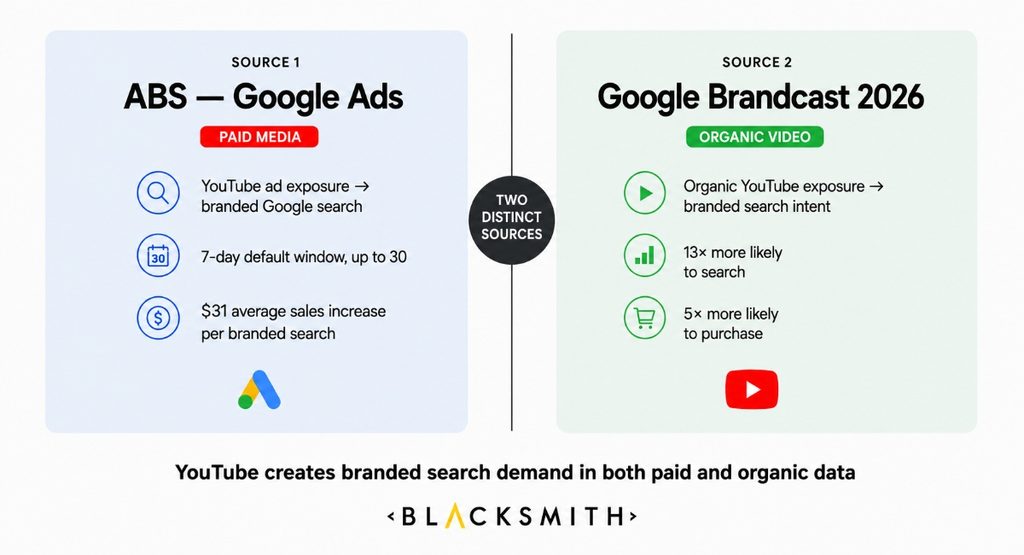
ABS was designed to measure what happens after someone sees a YouTube ad — but the behaviour it captures isn’t unique to advertising. Understanding why requires looking at what ABS actually tracks.
ABS is a paid media metric. It tracks users who saw a YouTube ad — not organic content. It does not directly prove that organic YouTube video creates branded searches.
What ABS reveals is a human behaviour pattern: people encounter YouTube content, form a brand impression, and search for that brand later — sometimes days later, sometimes weeks. The attribution window is adjustable up to 30 days precisely because this behaviour is not instantaneous. It is a slow-burn consideration process that eventually surfaces as intent in search.
That pattern was always operating. What changed on June 29, 2026 is that Google finally put a sales figure on what happens at the end of it.
The critical question is whether that same behaviour fires when the content is organic rather than paid.
What Does Google’s Own Data Say About Organic YouTube Videos?
The organic confirmation comes from Google Internal Data cited at YouTube Brandcast 2026, published separately from the ABS announcement. According to that data, viewers who watch organic YouTube video about a brand are:
- 13× more likely to make a branded Google search
- 5× more likely to make a purchase
These figures are not from the same dataset as ABS. The $31 sales lift figure applies specifically to the paid context that ABS measures and the CPG+ U.S. verticals it covers. These Brandcast 2026 figures are a distinct data point, from a distinct source, covering organic video exposure. Navigate Video’s coverage of YouTube Brandcast 2026 documents both statistics with their original attribution context.
There is a fair objection to the 13× figure, and it’s worth naming: someone who chooses to watch a video about a brand may already be predisposed toward it. Watching could be a symptom of intent rather than a cause of it.
That objection is exactly why the ABS data matters alongside it. Ad exposure is not self-selected — the viewer did not go looking for the brand, the ad interrupted them — and the branded searches followed anyway, in volumes Google was willing to attach a sales figure to. The paid data establishes that YouTube exposure creates search intent in people who weren’t already seeking the brand. The organic data shows the same behaviour operating at a scale no ad budget produced.
Neither figure settles the question alone. What survives the objection is the mechanism itself: YouTube creates awareness, builds consideration, and plants brand memory that re-emerges as search intent.
ABS quantifies the sales value of branded searches created by YouTube ad exposure. Separate Google Internal Data from Brandcast 2026 shows the same behaviour — see YouTube content, search for the brand later — fires from organic video too. Together, they make the case that organic YouTube is a measurable demand creation engine — not a social media play.
What Are Organic YouTube Videos Actually Worth in Search Terms?
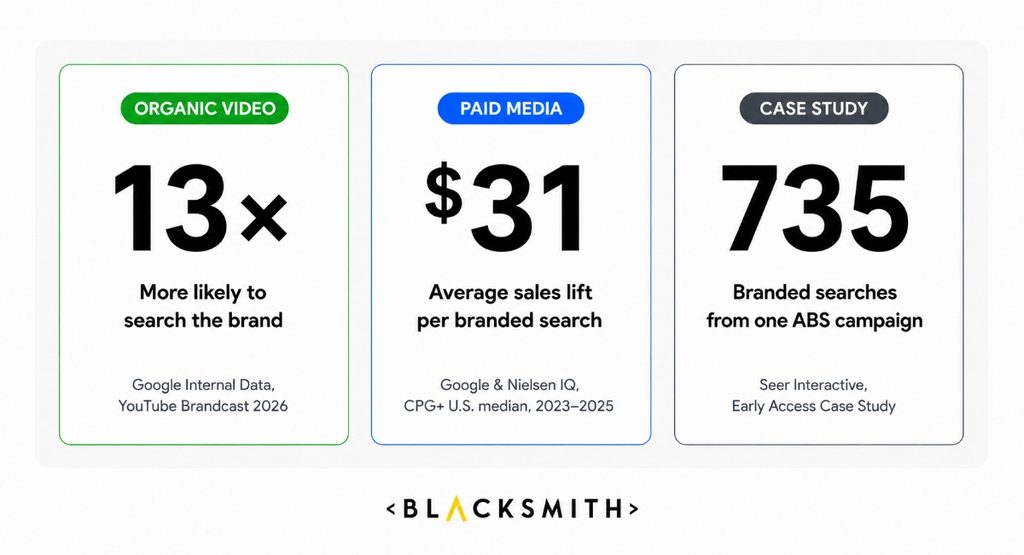
The underlying logic holds regardless: branded searches have measurable sales value, organic YouTube creates branded search intent, and most brands are not measuring the connection between the two.
Organic video content that achieves visibility in Google Search creates impressions. Those impressions drive brand awareness. That awareness generates branded search intent. That intent, according to ABS methodology, carries sales value at the end of the funnel.
Most brands have never attempted to put a value on the branded search demand their organic YouTube content creates. They haven’t had the tools to do it, but that changed in July 2026.
It’s also worth noting: organic YouTube video operates as a compounding asset library, not a campaign flight. Seer Interactive’s 735 branded searches came from a single paid campaign in a single month. An active organic YouTube channel producing consistent content across 12 or 24 months is building branded search demand from a growing library of content — each video adding to the pool. The compound effect of that demand creation, measured properly, is what reframes the ROI conversation for organic video entirely.
What Is GSC Platform Properties and How Does It Work?
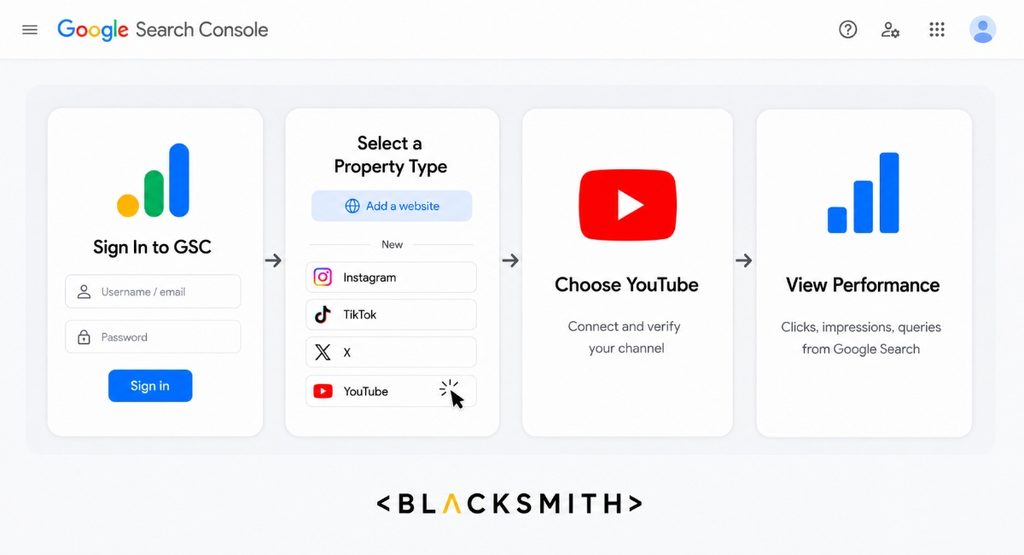
Until recently, there was no way for an organic SEO or content team to see how their YouTube videos were performing in Google Search without relying on indirect signals. Google introduced Platform Properties in Search Console on July 7, 2026, and made them globally available on July 29, 2026, alongside a new guide on analysing social and video content performance.
ABS requires a Google representative to activate and is built for paid campaigns. GSC Platform Properties is self-serve and shows the organic side of the same data story — add your YouTube channel as a property in Search Console and complete the authorisation steps to get started.
What GSC Platform Properties shows you
Once your YouTube channel is connected as a Platform Property in GSC, the Performance report surfaces:
- Clicks from Google Search and Discover to your YouTube videos
- Impressions — how many times your videos appeared in Google Search results
- Click-through rate and average position
- The specific search queries that led people to your YouTube content on Google
This is the data that connects your organic video content to real search behaviour. If a video you published six months ago is still generating impressions and clicks through Google Search, that now shows up in the same reporting environment as your website data.
How to connect your YouTube channel in GSC
- Sign in to Google Search Console
- Click Add Property
- Select Platform property as the property type
- Choose YouTube from the supported platform options
- Connect and verify your YouTube channel
- Open the Performance report to see clicks, impressions, queries, and position data for your YouTube content in Google Search
The setup takes minutes. The data it surfaces — which of your videos are generating Google Search impressions, which queries are finding them, and how they’re performing over time — is the starting point for any honest audit of what your organic video content is already doing in search.
ABS tells you what a branded search is worth at the point of sale. GSC Platform Properties shows which of your YouTube videos are receiving impressions and clicks from Google Search, Discover, and Google News — and which search queries are surfacing them. They are the paid and organic sides of the same measurement argument — both now available inside Google’s own toolset.
Does Organic YouTube Content Help With AI Search Visibility Too?
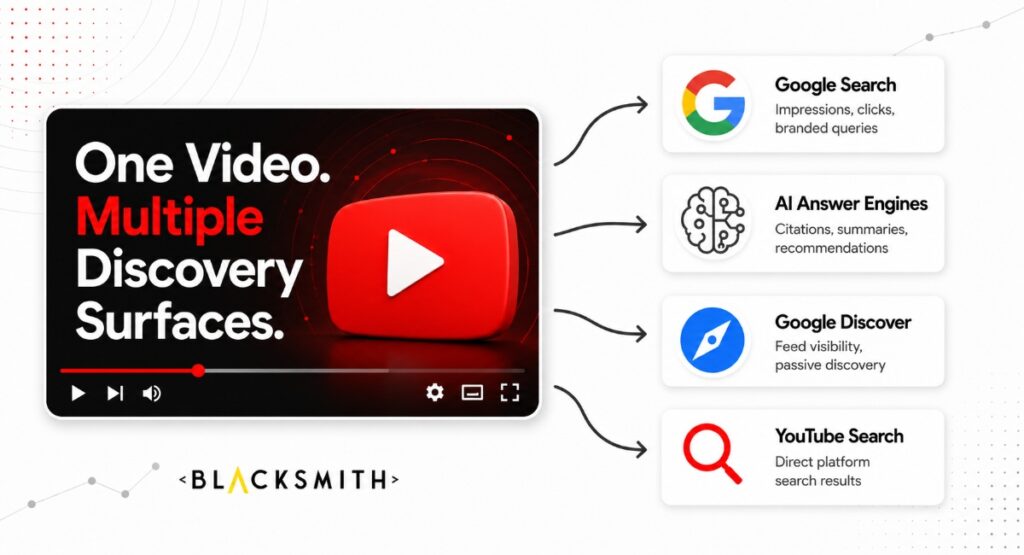
Yes — and it compounds the primary argument, particularly for brands building an AEO strategy alongside traditional SEO.
YouTube video is one of the most machine-readable content formats available to brands. Transcripts, metadata, chapter markers, descriptions, and closed captions are all structured, indexable, and available to AI answer engines. As Digiday reported in February 2026, Ómar Thor Ómarsson, CEO of Optise, observed that “YouTube is highly machine-readable and tends to be a low-risk source for AI to summarise and cite.” Jessica Finch, Head of SEO at Brainlabs, noted that “YouTube has evolved from a pure social channel play into a major focus for AI visibility strategies.”
LLM-powered systems — ChatGPT Search, Perplexity, Gemini, and similar AI answer engines — draw heavily on organic content that lives on the open web with genuine engagement signals. A YouTube video with a clean transcript, accurate metadata, and meaningful watch time is well-positioned to be cited or surfaced by these systems, in addition to appearing in traditional Google Search results.
The downstream benefit is doubled: organic YouTube content creates branded search demand in traditional search (confirmed by Brandcast 2026 data), and feeds the AI answer systems that are increasingly shaping discovery for a growing share of queries. Both channels compound over time. Both are served by the same video content investment.
For brands building AEO strategy alongside traditional SEO, organic YouTube content belongs in the same conversation from the start. Our YouTube SEO guide covers how video contributes to visibility across both traditional and AI-mediated search surfaces.
How Should This Change Your Video Content Strategy?
For brands and agencies that have been building organic YouTube into SEO programmes, ABS and the Brandcast 2026 data are a confirmation, not a new direction.
Search engines have always been demand harvesters. They are built to capture and convert intent that already exists. When someone searches for your brand on Google, they already know you exist — something planted that awareness before they ever opened a search bar. For most brands, a meaningful share of that planted awareness is coming from YouTube, whether they’re measuring it or not.
Search itself has changed, which raises the stakes on that upstream work. As Kristina Frunze, Head of Strategy at WebView SEO, put it at SEO Estonia 2026: “Search no longer points you to answers. It is the answer.” If search has become the destination rather than the directory, then the demand it harvests has become the strategic prize — and brands that aren’t actively creating that demand upstream are competing over a finite and shrinking pool of people who already knew to look for them. Organic YouTube is how you expand that pool.
What changed in June and July 2026 is that Google published the data to prove it — and gave every brand the tools to measure their own version of it. ABS puts a sales figure on the end of the journey for paid content. GSC Platform Properties opens the measurement up to organic content. The Brandcast 2026 data confirms the journey begins from organic video exposure, not just paid.
At Blacksmith, we have been making this argument to clients before the data existed to back it up formally. Organic video is a search demand creation engine. It belongs at the centre of any modern SEO strategy — not as an add-on, but as the upstream input that determines how much branded search demand a brand generates over time. ABS is Google publishing the proof. For clients who have heard this from us, that confirmation should land with weight.
The upstream input that determines the quality of that demand creation is topic strategy — which videos get made, around which keywords, for which audiences. Our piece on using YouTube Studio’s Inspiration tab for content strategy covers that process in detail. The better the topic selection, the higher the branded search intent generated downstream.
(For more on ensuring that once someone clicks through from search, the video itself holds attention and drives the signals YouTube rewards, our YouTube audience retention guide covers the production side.)
How Do You Build a Video Strategy Around Branded Search Demand?
The demand creation is already happening. Organic YouTube videos can create brand impressions that may later surface as branded searches on Google — searches that, according to Google’s own data, carry measurable downstream sales value. What’s missing for most brands isn’t the mechanism. It’s the measurement.
GSC Platform Properties makes that measurement possible, today, in the tools your team already uses. The question is whether your video content strategy is built to take full advantage of what it’s already generating.
At Blacksmith, we build organic video and content programmes connected to search strategy from the start — video topics chosen for the branded search demand they create, production built to hold attention and earn algorithmic distribution, and reporting tied to the signals that actually move the needle. If you want to understand what your organic YouTube content is already generating in Google Search, or if you’re ready to build a video strategy around measurable demand creation, let’s talk.
Frequently Asked Questions
What is Attributed Branded Searches (ABS)?
Attributed Branded Searches (ABS) is a reporting metric in Google Ads, launched globally on June 29, 2026, that tracks the volume of branded Google searches triggered by a YouTube ad impression or view. It uses view-through attribution with a default 7-day window, editable between 1 and 30 days, and is reporting-only — it appears under All Conversions and the Consideration goal and cannot be used as a Smart Bidding goal. It was first introduced at Google Marketing Live 2025. Activation requires Brand Mapping setup and a Google representative.
Does ABS apply to organic YouTube content?
No — ABS itself is a paid media metric that tracks users who saw a YouTube ad, not organic content. However, separate Google Internal Data cited at YouTube Brandcast 2026 confirms the same behaviour fires from organic video: viewers of organic YouTube content about a brand are 13× more likely to make a branded Google search. These are two distinct data sources that together make the case for organic video as a demand creation engine.
What is the $31 figure and where does it come from?
The $31 figure represents the average increase in sales for every additional branded search generated following a YouTube ad impression or view. It comes from Google and Nielsen IQ offline sales data between 2023 and 2025, as a median across 500+ U.S. advertisers in CPG+ verticals — Consumer Packaged Goods, Tech, Education and Government, Media and Entertainment, Auto, and Healthcare. It is not a universal figure applicable to all industries or geographies. Published by Google on June 29, 2026.
What are GSC Platform Properties?
GSC Platform Properties are a new property type in Google Search Console, introduced July 7, 2026 and made globally available on July 29, 2026, that lets brands connect social media and video accounts — including YouTube — to see how their content performs in Google Search, Discover, and Google News. The Performance report shows clicks, impressions, CTR, average position, and the specific search queries that surfaced your YouTube content on Google.
How do I connect my YouTube channel to Google Search Console?
Sign in to Google Search Console, click Add Property, select Platform property as the property type, choose YouTube from the supported platforms, then connect and verify your channel. The Performance report will show how your organic YouTube videos are performing in Google Search — including which search queries are finding them. No Google representative required.
How does organic YouTube content affect AI search visibility?
YouTube video content is highly machine-readable: transcripts, metadata, chapter markers, and descriptions are all structured and indexable. AI answer engines — including ChatGPT Search, Perplexity, and Gemini — draw on organic content with genuine engagement signals. A well-structured YouTube video with accurate metadata and meaningful watch time is well-positioned to be cited or surfaced by these systems, extending the reach of the same content investment that drives branded search demand in traditional Google Search.
Do I need a Google rep to use ABS?
Yes. ABS requires Brand Mapping setup and activation by a Google representative — it cannot be self-activated in Google Ads settings. GSC Platform Properties, by contrast, is fully self-serve and available to any Google Search Console user with no rep required. Both measure related but distinct sides of the YouTube-to-search relationship.
